New social role

Active involvement in the Fondazione Trentina per l'Autismo organization, where I could actually interact with the client.

Metadesign approach

Producing an advanced and plausible concept as a result, without focusing on manufacturability aspects.

Professional organizational tools

First personal use of Dataviz (Matrix, Venn Diagram) and other concept generation tools (Crazy Eight, Personas, Journey Map, Tier Lists).

Pysical models over drawings

The project development was mostly based on study models, wich eventually evolved into the final prototypes.

Lateral
thinking, spot-
on solutions.

New social role

Active involvement in the Fondazione Trentina per l'Autismo organization, where I could actually interact with the client.

Metadesign approach

Producing an advanced and plausible concept as a result, without focusing on manufacturability aspects.

Professional organizational tools

First personal use of Dataviz (Matrix, Venn Diagram) and other concept generation tools (Crazy Eight, Personas, Journey Map, Tier Lists).

Physical models over drawings

The project development was mostly based on study models, wich eventually evolved into the final prototypes.

Redescovering simplicity

Very often, this job leads to unnecessary complications. In this case, I rediscovered the value of simple objects, supported by strong concepts.

Thinking with hands

This project also confirmed my preference for producing physical models to propose ideas during the development phase, rather than drawings.

Back to the origins

I discovered a new aspect of design: the artisanal one, made of sweat and sawdust, with the priceless satisfaction of using a self-produced object on a daily basis.

Lateral
thinking, spot-
on solutions.

Rediscovering simplicity

Very often, this job leads to unnecessary complications. In this case, I rediscovered the value of simple objects, supported by strong concepts.

Thinking with hands

This project confirmed my preference for producing physical models to propose ideas during the development phase, rather than drawings.

Back to the origins

I discovered a new aspect of design: the artisanal one, made of sweat and sawdust, with the priceless satisfaction of using a self-produced object on a daily basis.

Importance of history

Rediscovering Cisitalia taught me the importance of curiosity and research in every project.

Formal reinterpretation

This project trained me for a common challenge in the design industry: the formal rebranding in search for a new corporate identity.

3D modelling

The project gave me the opportunity to delve deeper into parametric surface modeling, using an unconventional software: ZW3D.

Hunger for improvement

This experience left me with the desire to improve my rendering and 3D printing skills, which I actually refined in subsequent projects.

Lateral
thinking, spot-
on solutions.

Importance of history

Rediscovering Cisitalia taught me the importance of curiosity and research in every project.

Formal reinterpretation

This project trained me for a common challenge in the design industry: the formal rebranding in search for a new corporate identity.

3D modelling

The project gave me the opportunity to delve deeper into parametric surface modeling, using an unconventional software: ZW3D.

Hunger for improvement

This experience left me with the desire to improve my rendering and 3D printing skills, which I actually refined in subsequent projects.

Role of poetry

The relationship between light and ceramic material is common to all of the concepts. I am more convinced than ever of the importance of poetry in the designer's craft.

Importance of mistakes

Krakatoa is the result of a great deal of trial and error, from which I've always drawn something new. I believe that this is fundamental in a designer's career.

Boost on drawingss

This is a project that required a lot of sketching. This gave me the opportunity to refine this aspect of design and better define my style.

New softwares

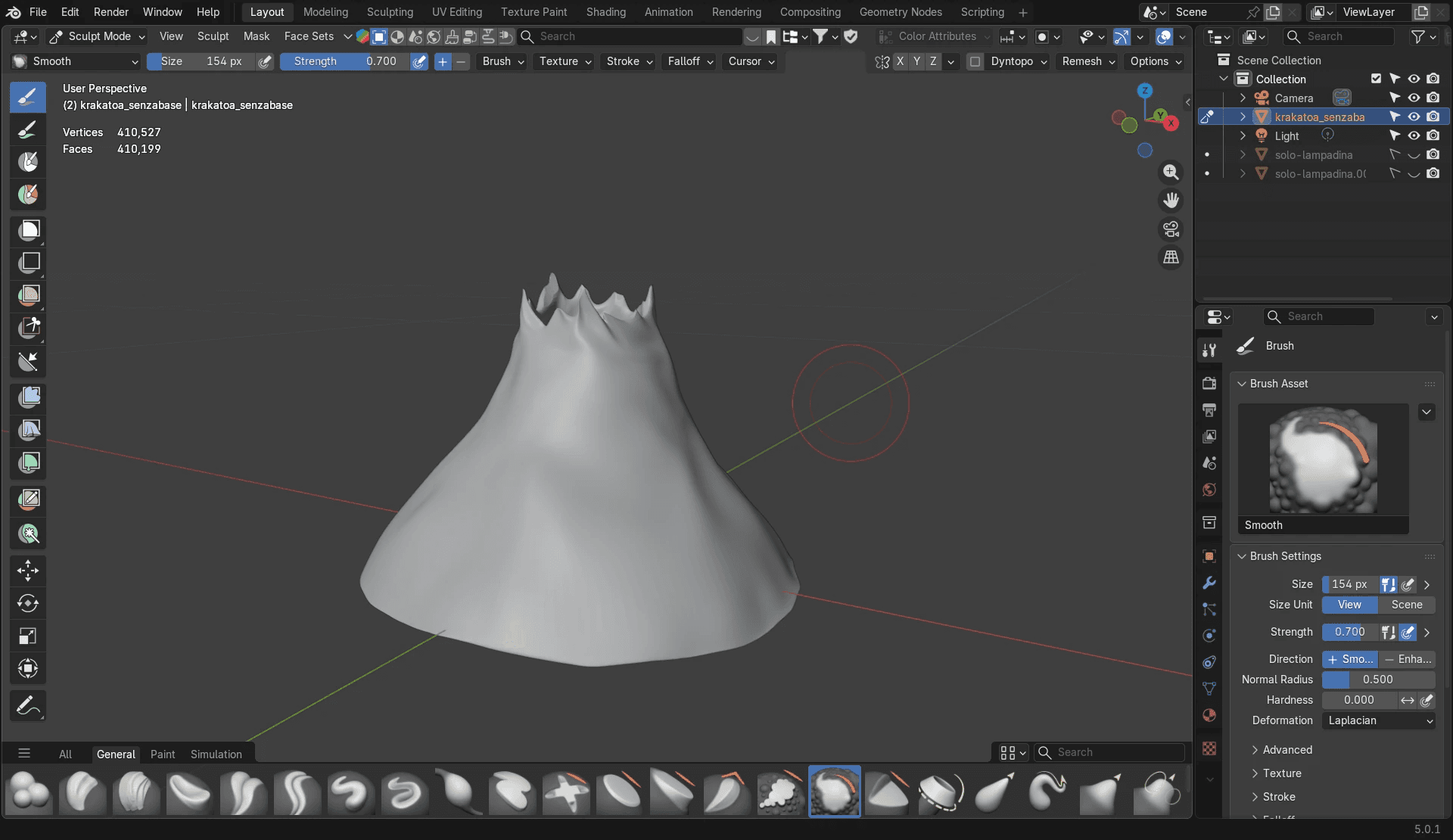
Designing Krakatoa gave me the chance to deepen my knowledge of Fusion 360 and start using Blender for organic shapes and renderings.

In search of perfection

This project taught me more than any other to never stop at the first idea and be willing to start over, revolutionize an idea in search of the best possible result.

Lateral
thinking, spot-
on solutions.

Role of poetry

The relationship between light and ceramic material is common to all of the concepts. I am more convinced than ever of the importance of poetry in the designer's craft.

Importance of mistakes

Krakatoa is the result of a great deal of trial and error, from which I've always drawn something new. I believe that this is fundamental in a designer's career.

Boost on drawings

This is a project that required a lot of sketching. This gave me the opportunity to refine this aspect of design and better define my style.

New softwares

Designing Krakatoa gave me the chance to deepen my knowledge of Fusion 360 and start using Blender for organic shapes and renderings.

In search of perfection

This project taught me more than any other to never stop at the first idea and be willing to start over, revolutionize an idea in search of the best possible result.

Krakatoa

Krakatoa is a 3D printed ceramic ceiling lamp. The ceramic shell hides the ceiling canopy, the cable, and the bulb socket. The LED bulb thus appears as a pure luminous sphere, emerging from the ceramic. 3D printing is used to create a natural and organic shape, where the layers remain exposed, without colors or glazes, to give an effect similar to real rock.

Dexter & Sugar

ROLE

Concept generation, development, 3D modelling, prototyping, rendering.

BRIEF

Designing a 3D printable ceramic lamp for the contract sector, that only uses Creative Cables components.

NOTES

The project was developed individually for the Laboratorio di Sintesi Finale del Progetto (Final Synthesis Laboratory).

Concept Generation

Slater

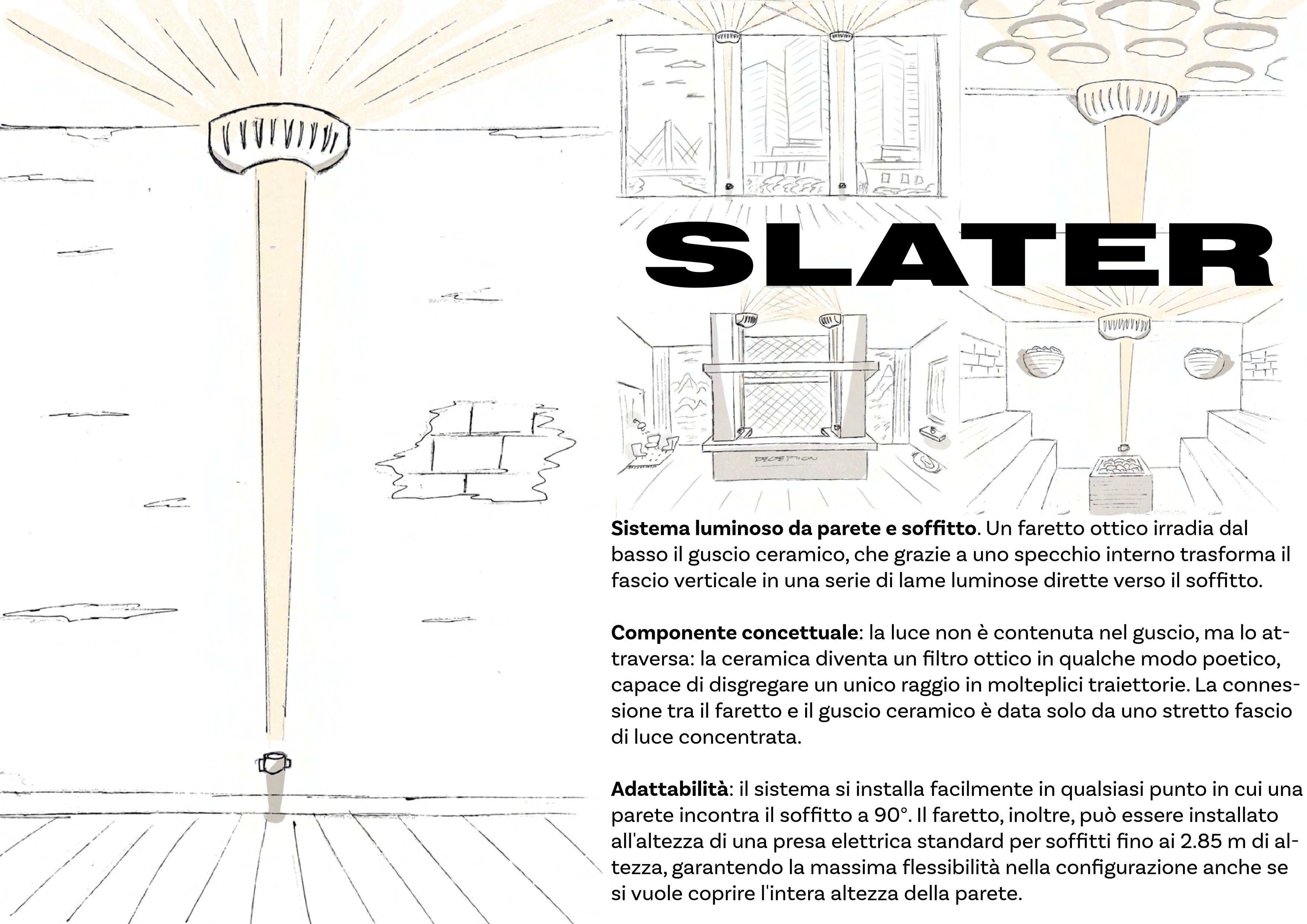
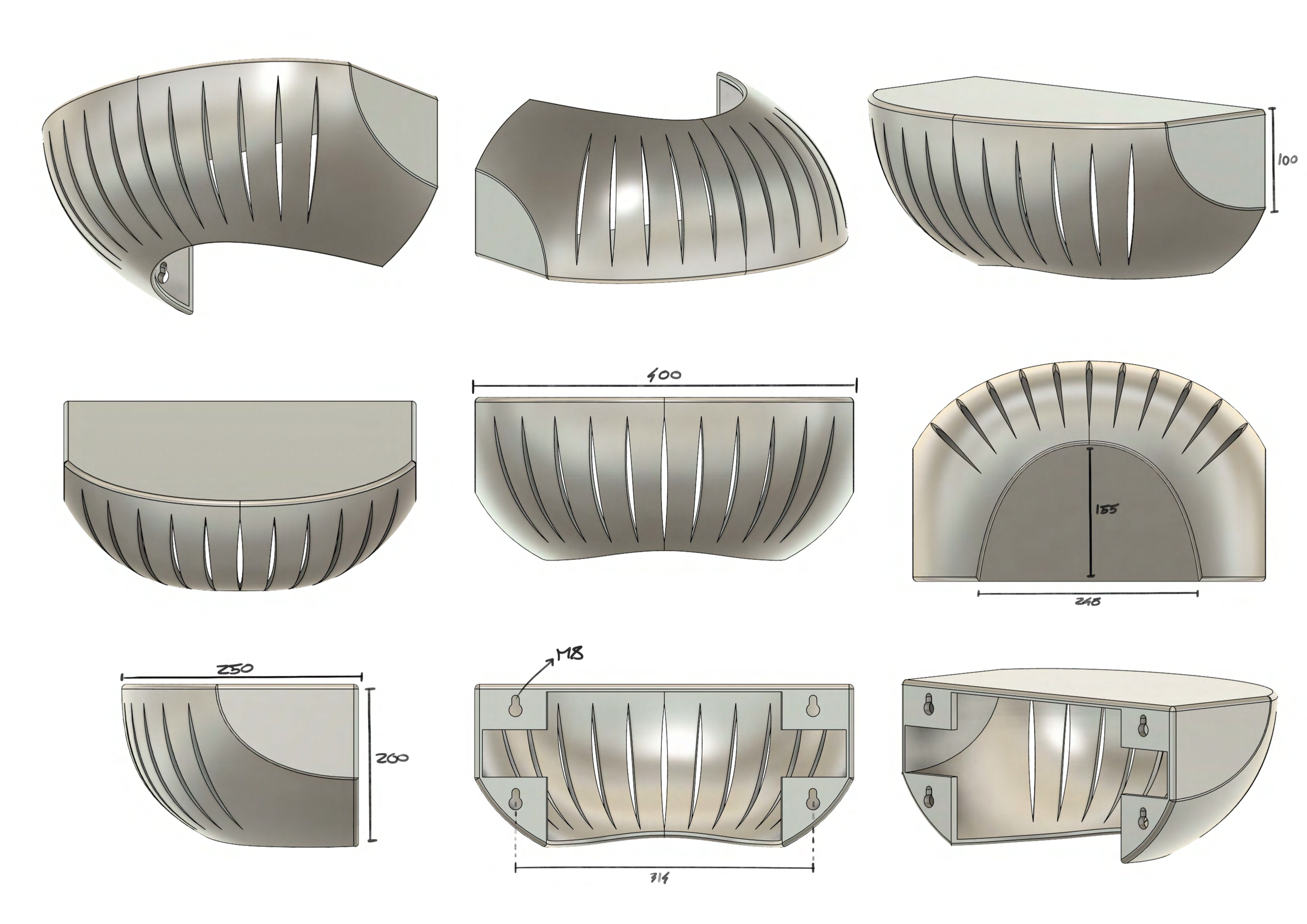
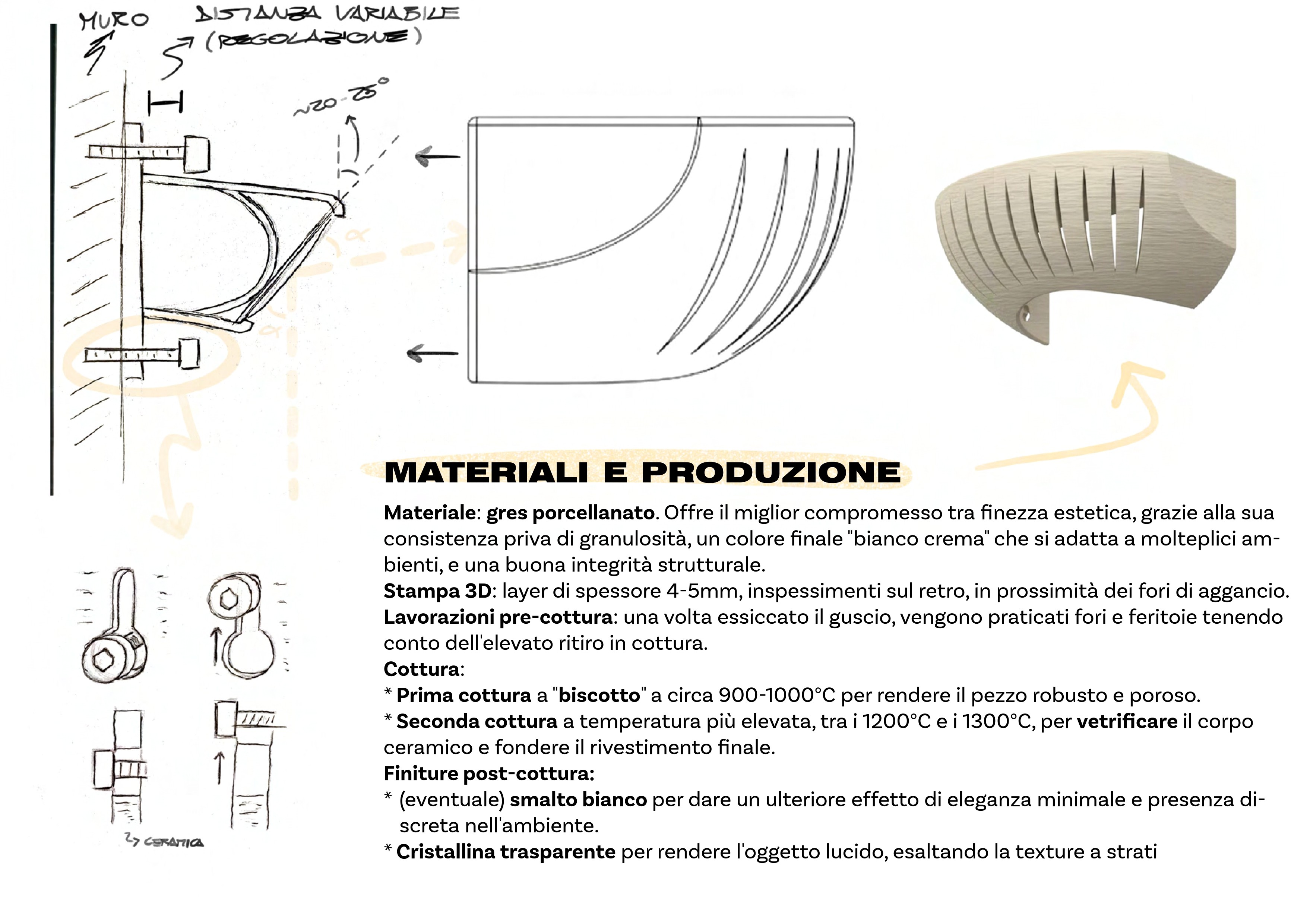
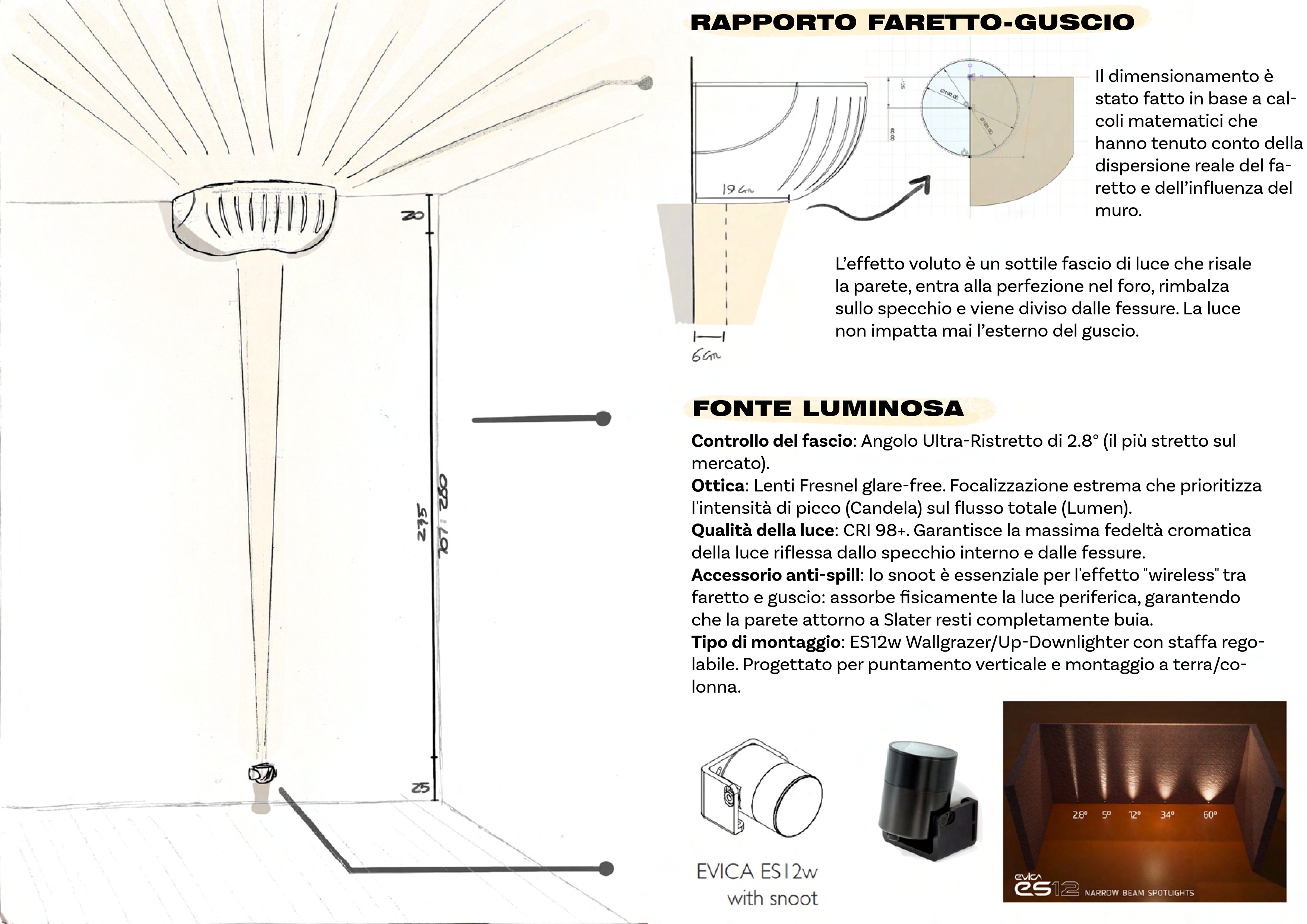
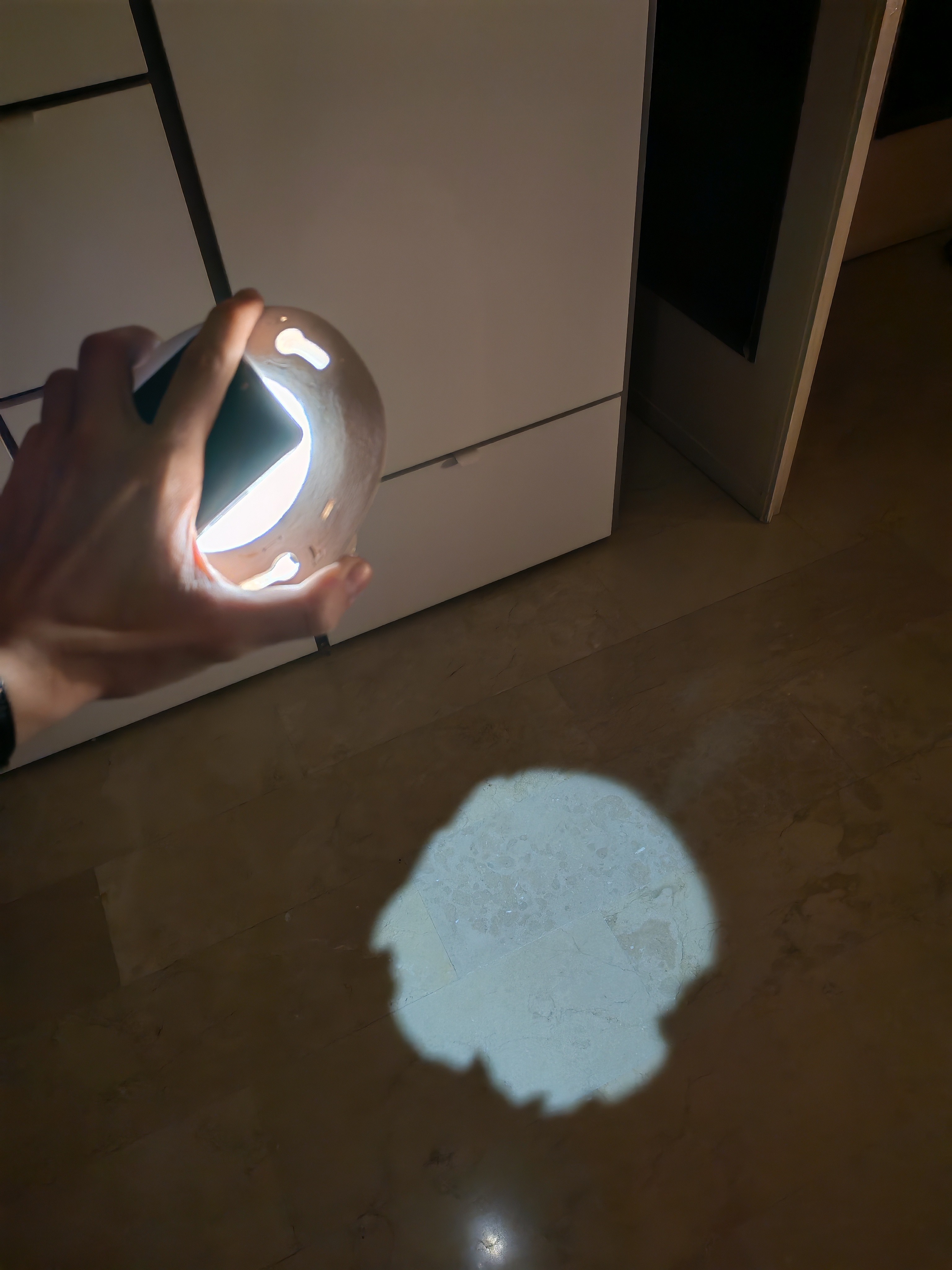
The project has been a long process. The first version was called Slater: it consisted in a ceramic shell positioned on the edge between the wall and the ceiling, containing a deflector mirror, combined with a specific, high-performance spotlight. The spotlight, pointed upward, emits a beam that visibly climbs the wall, entering precisely into the lower hole in the shell. The mirror deflects the beam, which splits into eleven different rays that illuminate the ceiling.

Image 1
Image 2
Image 3
Image 4

In the end, the project wasn't carried on because the shell wasn't printable in ceramic and it didn't use Creative Cables components. I then shelved this idea (maybe for a future project) and proposed another lamp for the final submission: Stalattite.

Stalattite

In Stalattite, I radically changed the shape and the concept, but i kept following the path of poetry.

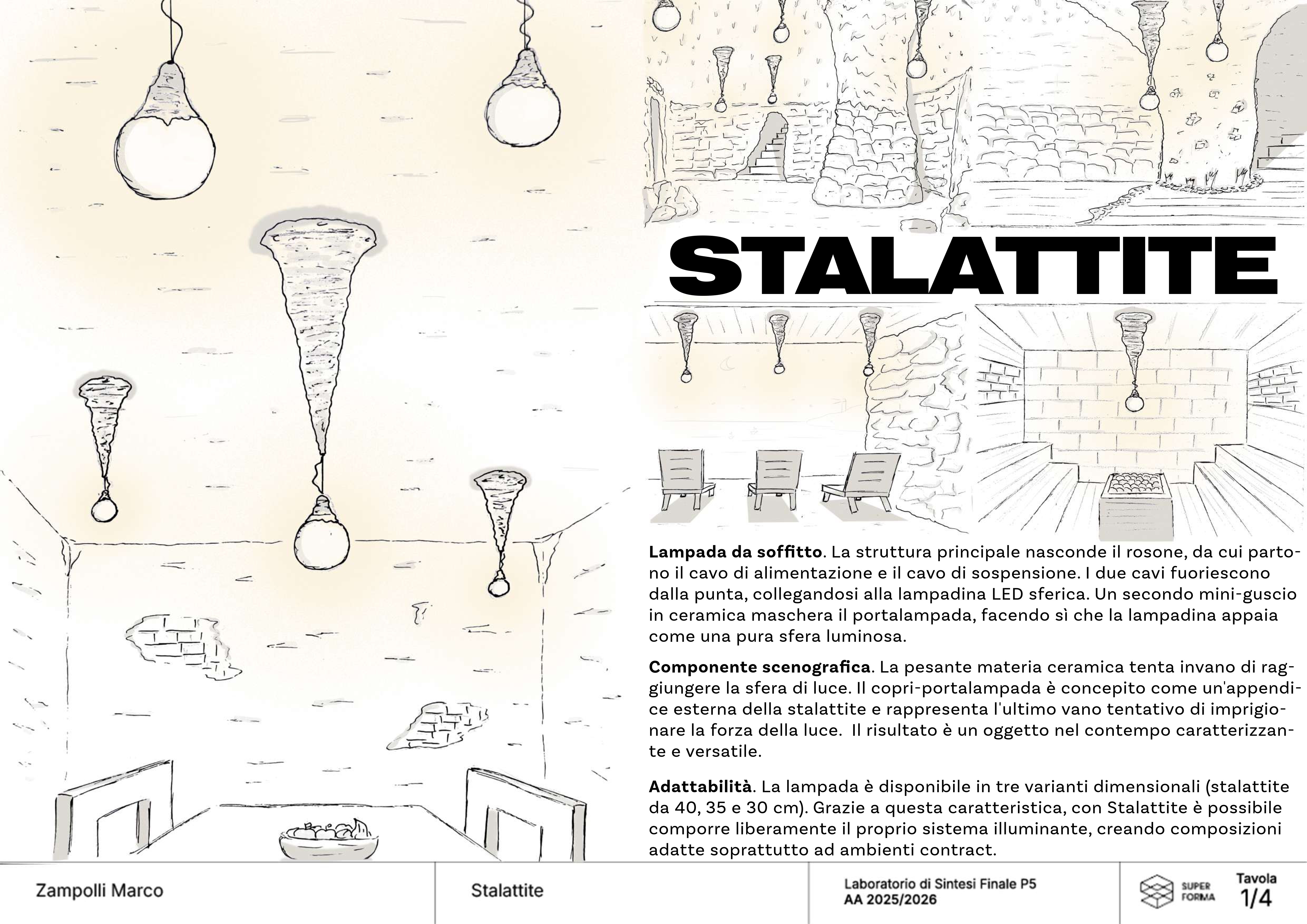
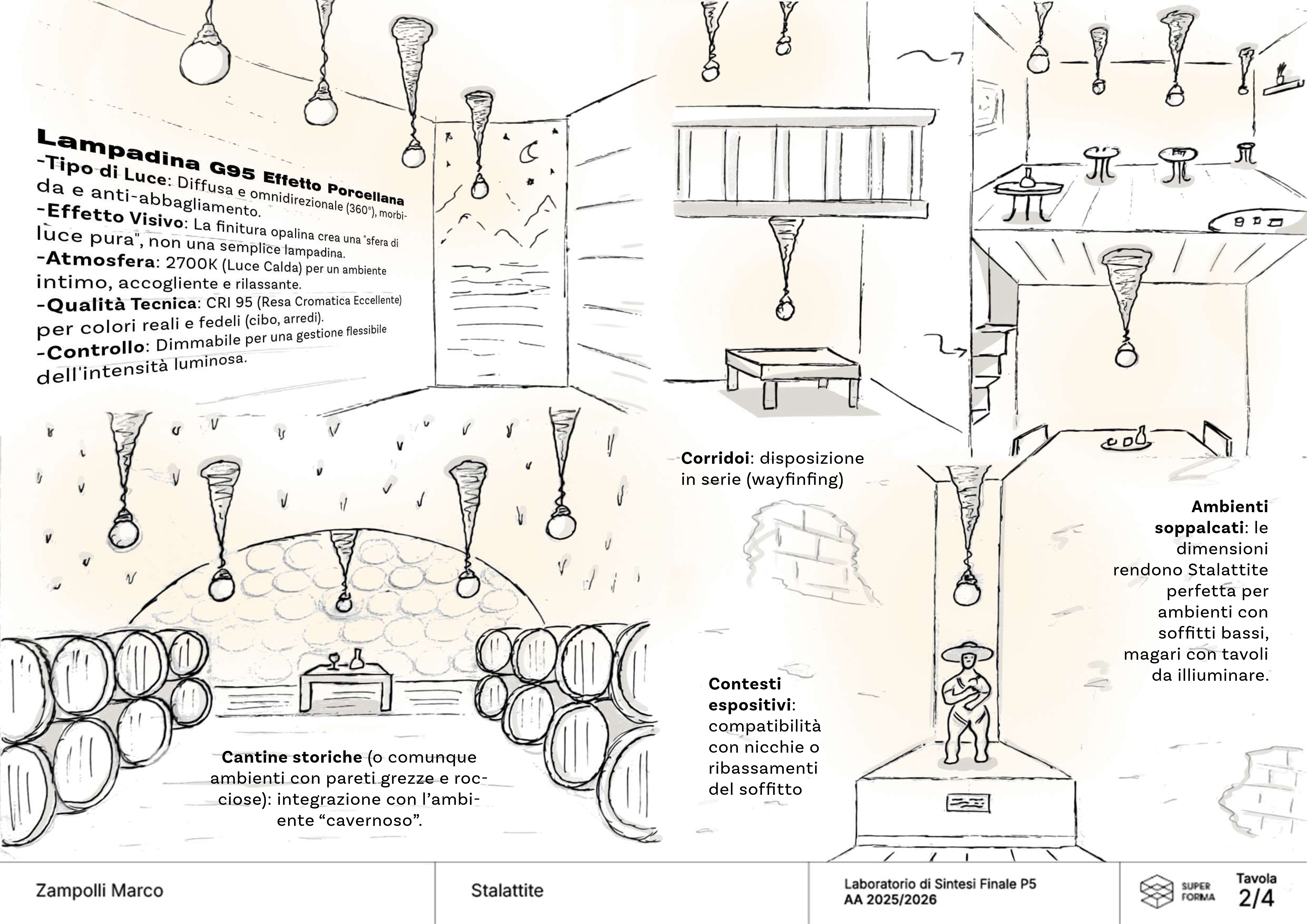
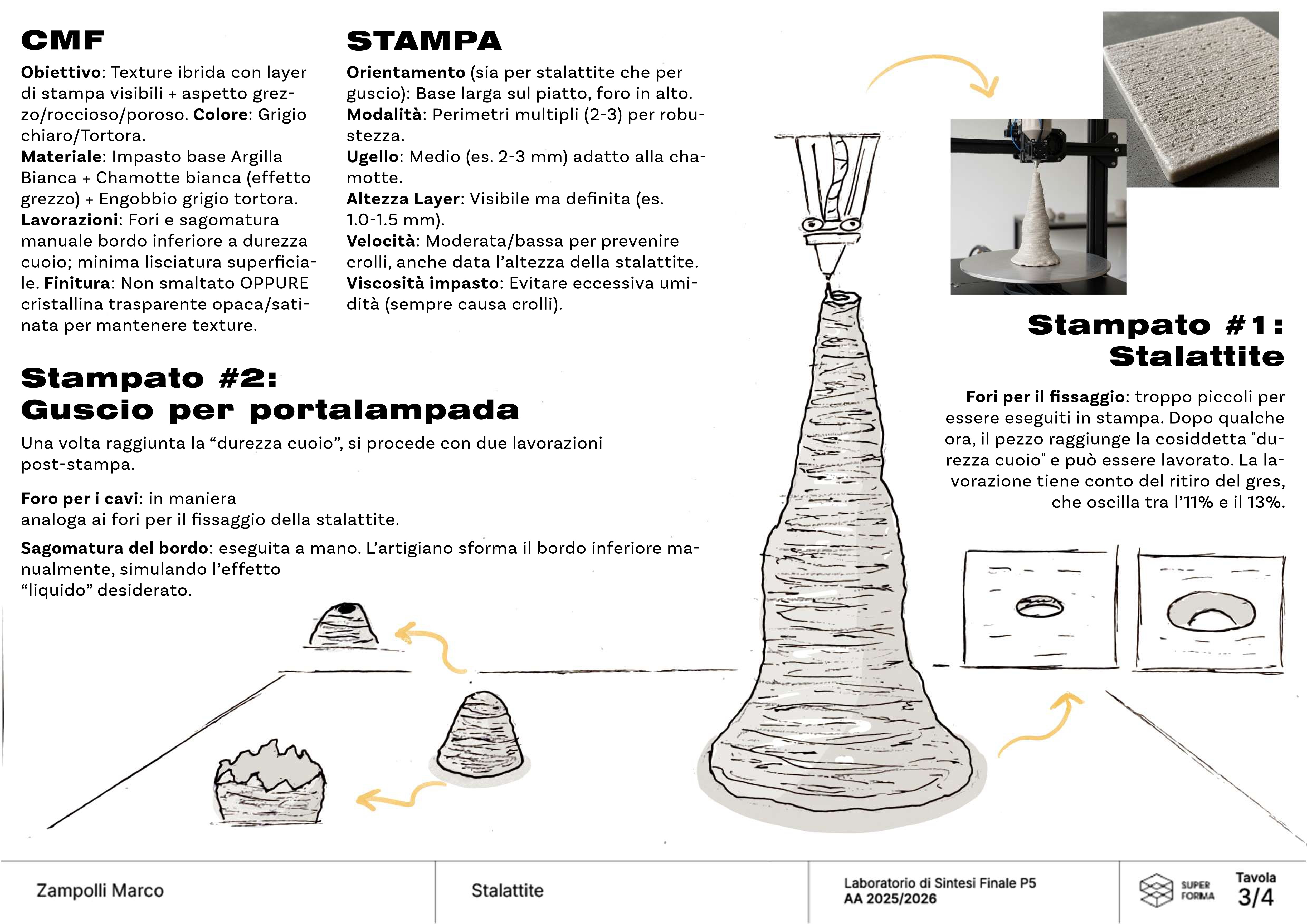
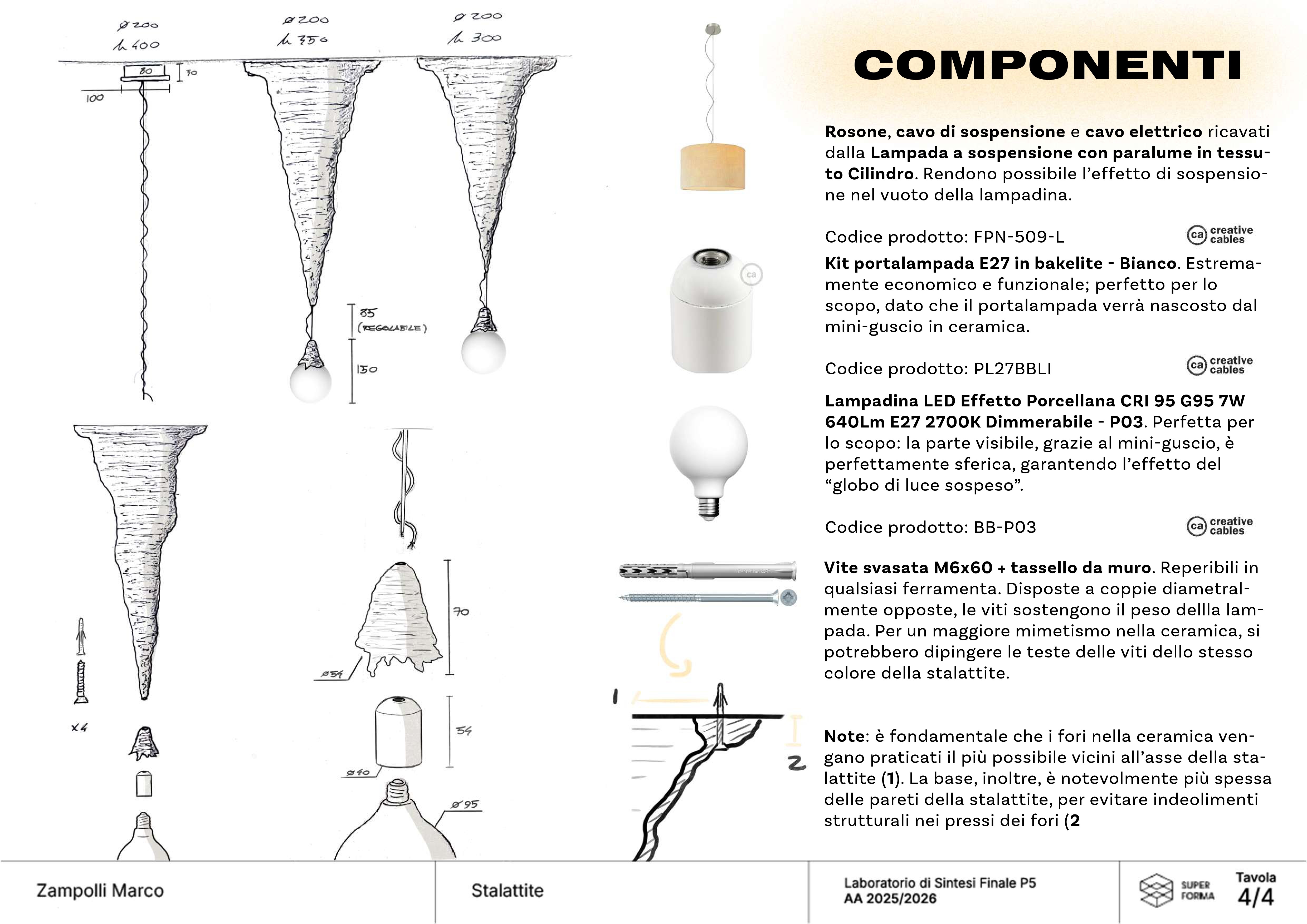
The main structure hides the ceiling canopy, from which the power cable and suspension cord start. The two cables emerge from the tip, connecting to the spherical LED bulb. A second mini-ceramic shell conceals the bulb socket, making the bulb appear as a pure sphere of light.

The heavy ceramic material attempts in vain to reach the sphere of light. The bulb socket cover is designed as an external appendage of the stalactite and represents a last, futile attempt to capture the power of the light. The result is an object both distinctive and versatile.

The lamp is available in three sizes (40, 35, and 30 cm stalactite). Thanks to this feature, Stalattite allows you to freely compose your own lighting system, creating compositions especially suited to contract environments.

Image 1
Image 2
Image 3
Image 4
Image 5

After submitting the project, I had the option to confirm it or modify it for the final exam. Deeming it still incomplete and difficult to print, I decided to improve it and generate a new object: Krakatoa.

Krakatoa

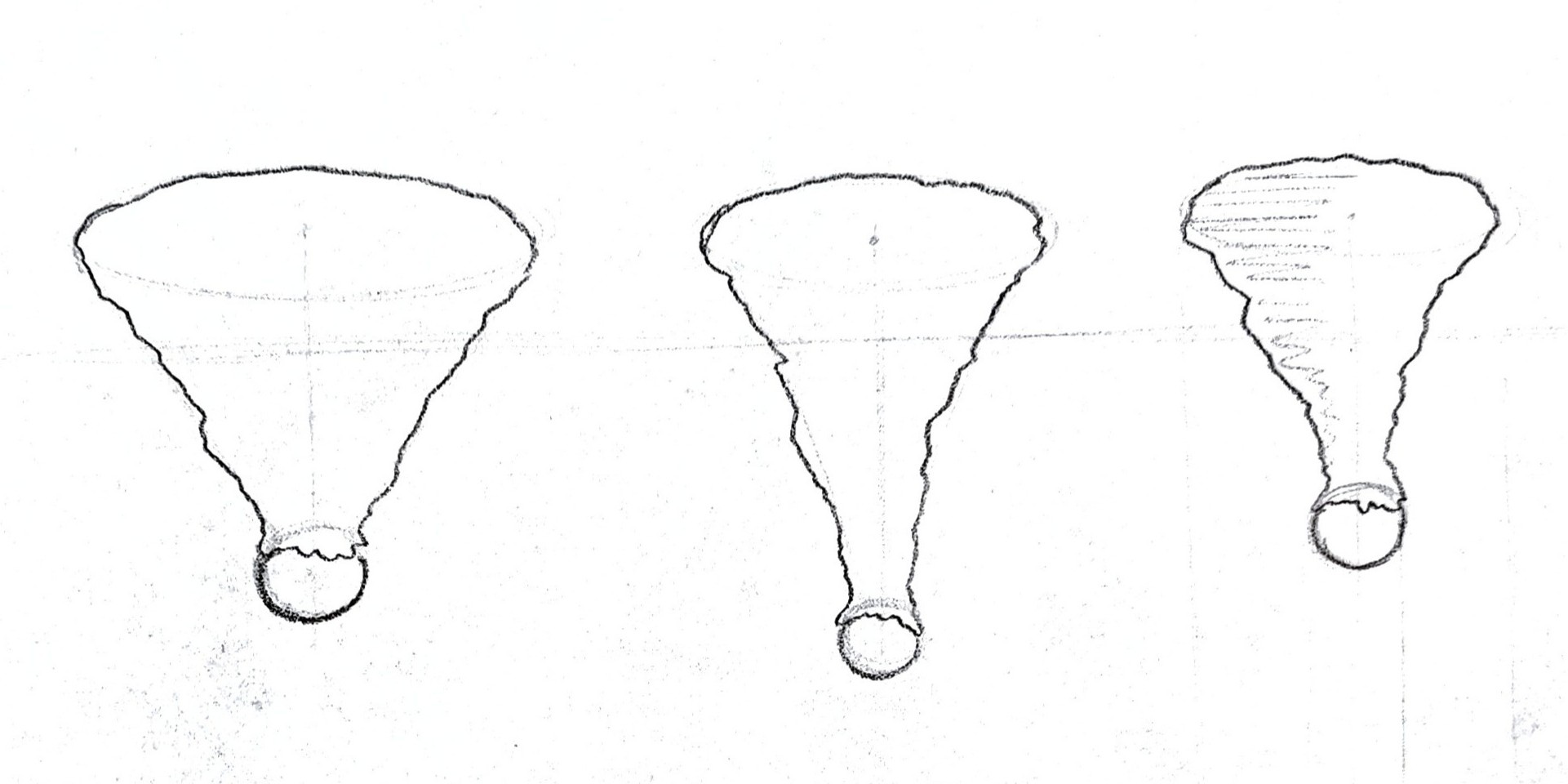
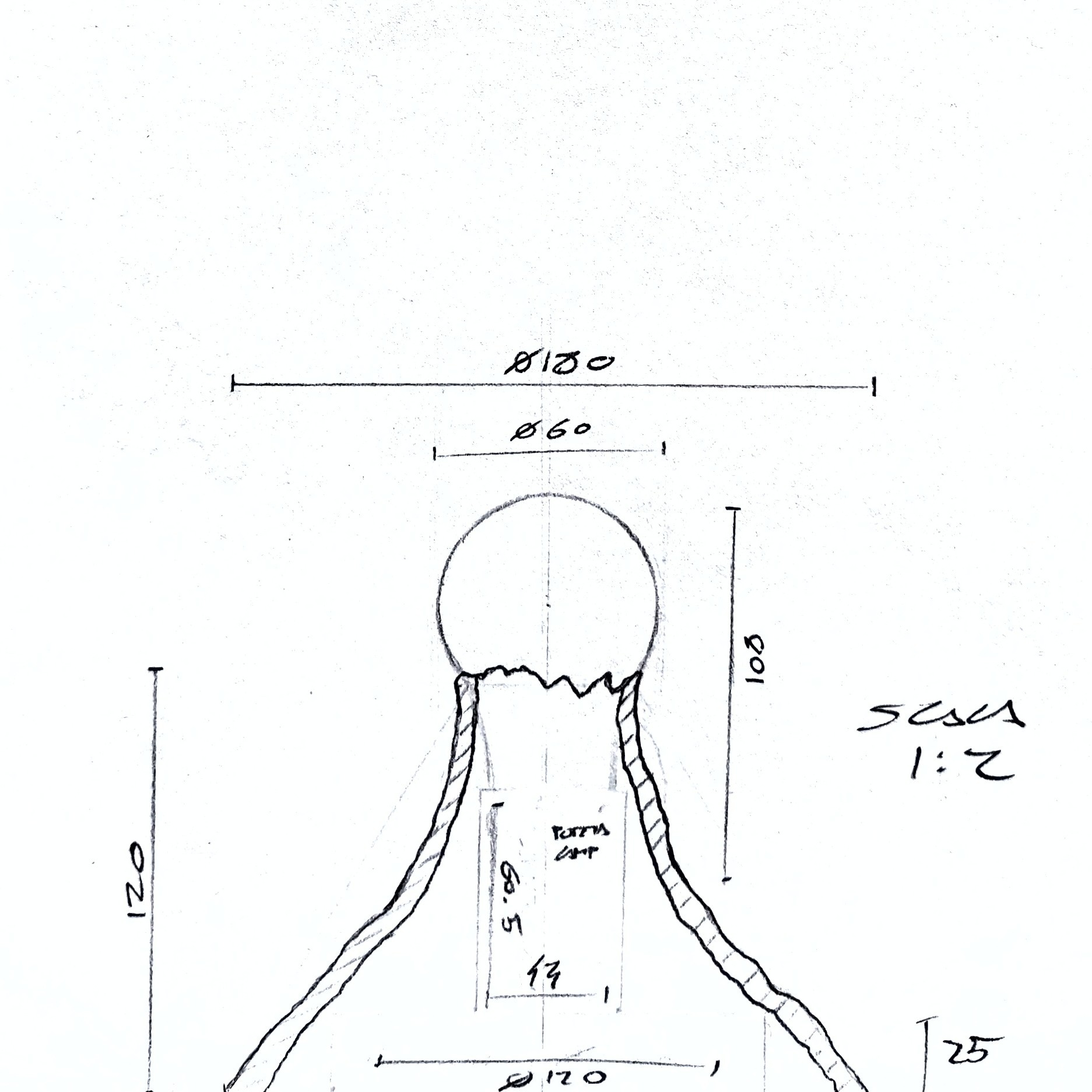
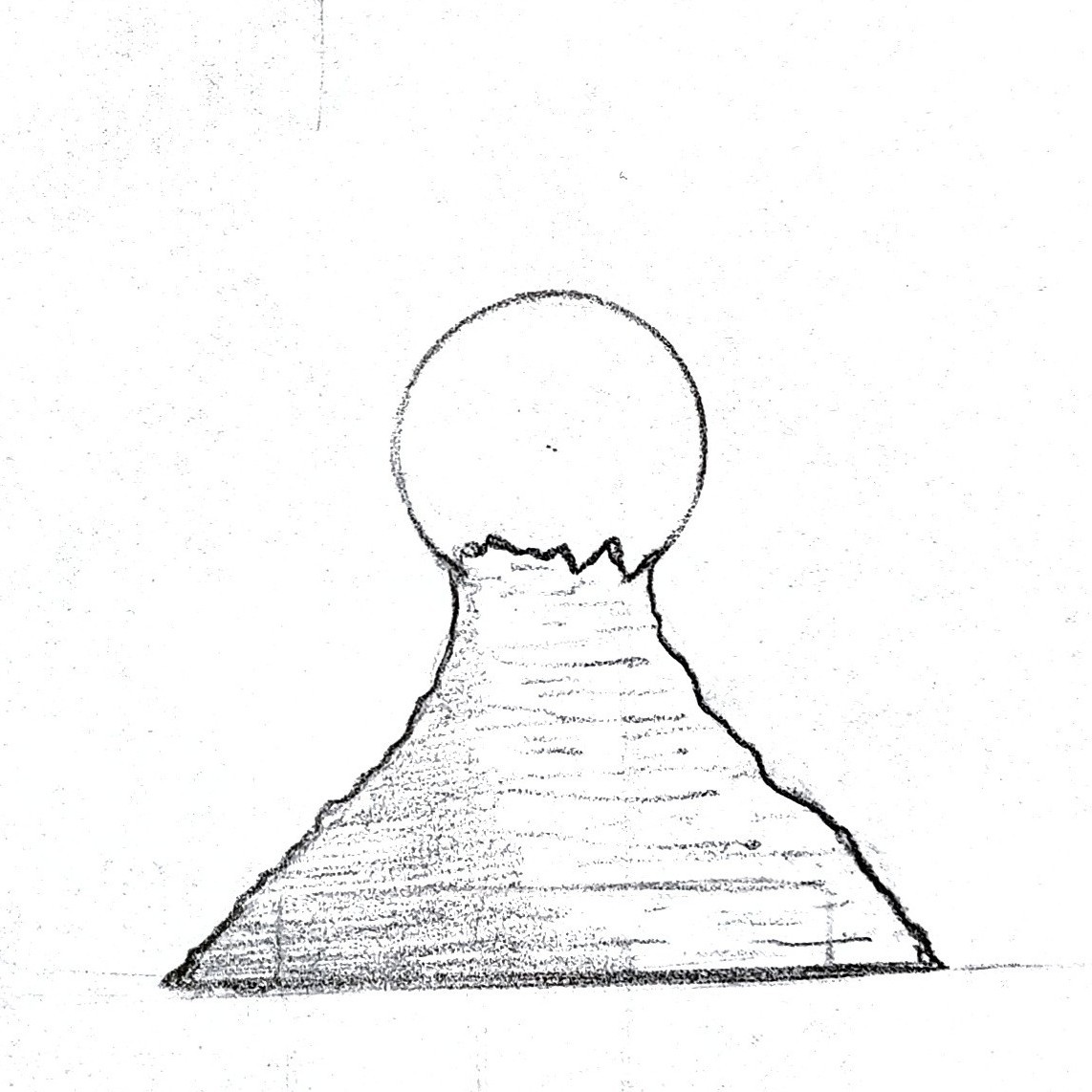
In order to avoid printing problems, I changed the nature of the product: from a pendant lamp to a ceiling lamp, without the use of dangling cables. The shape was thus flattened, resulting in a much more compact object, more reminiscent of a volcano than a stalactite; hence the name Krakatoa, always following the thread of light that "escapes" from the heavy, amorphous ceramic material.
Development

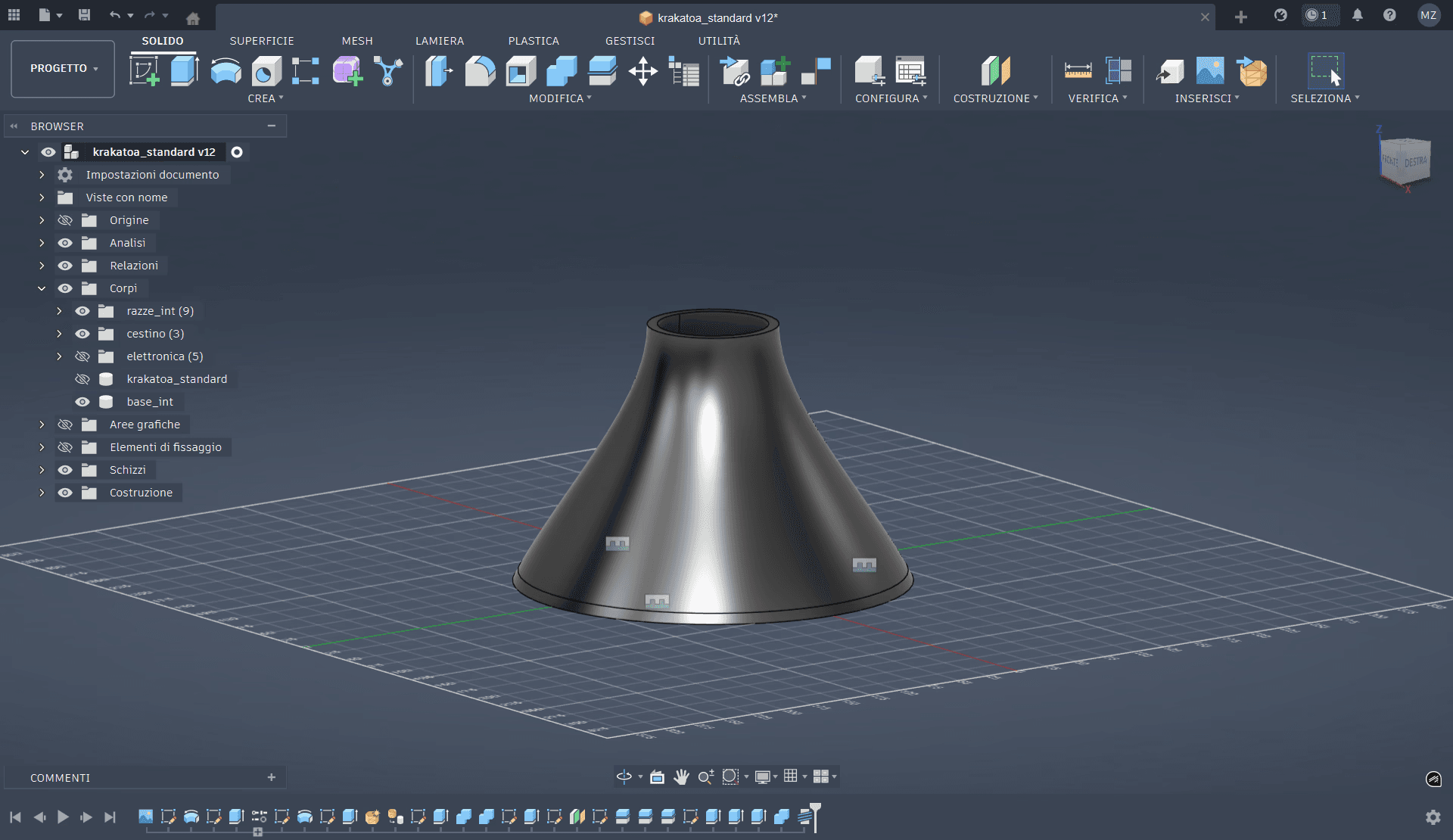
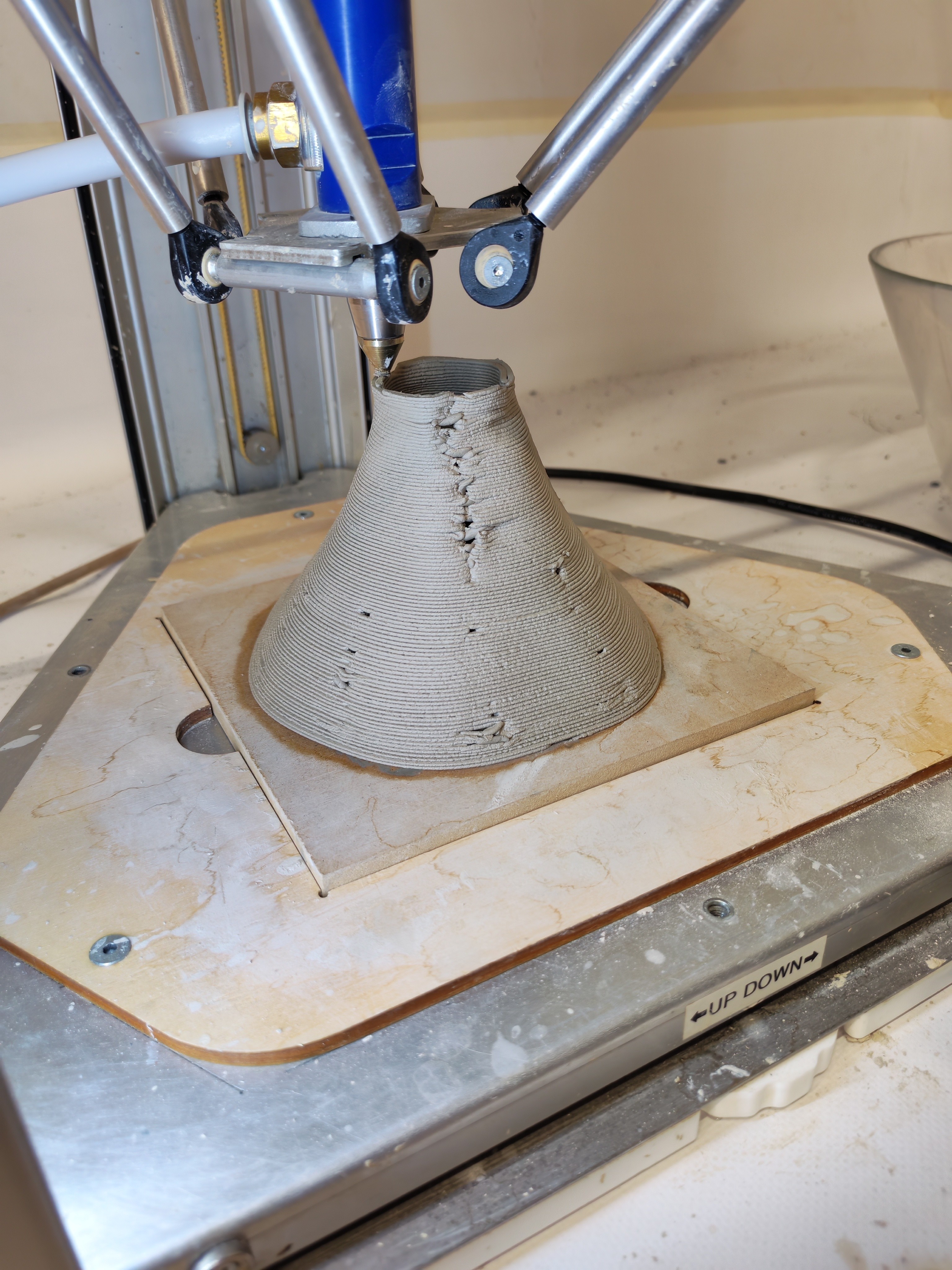
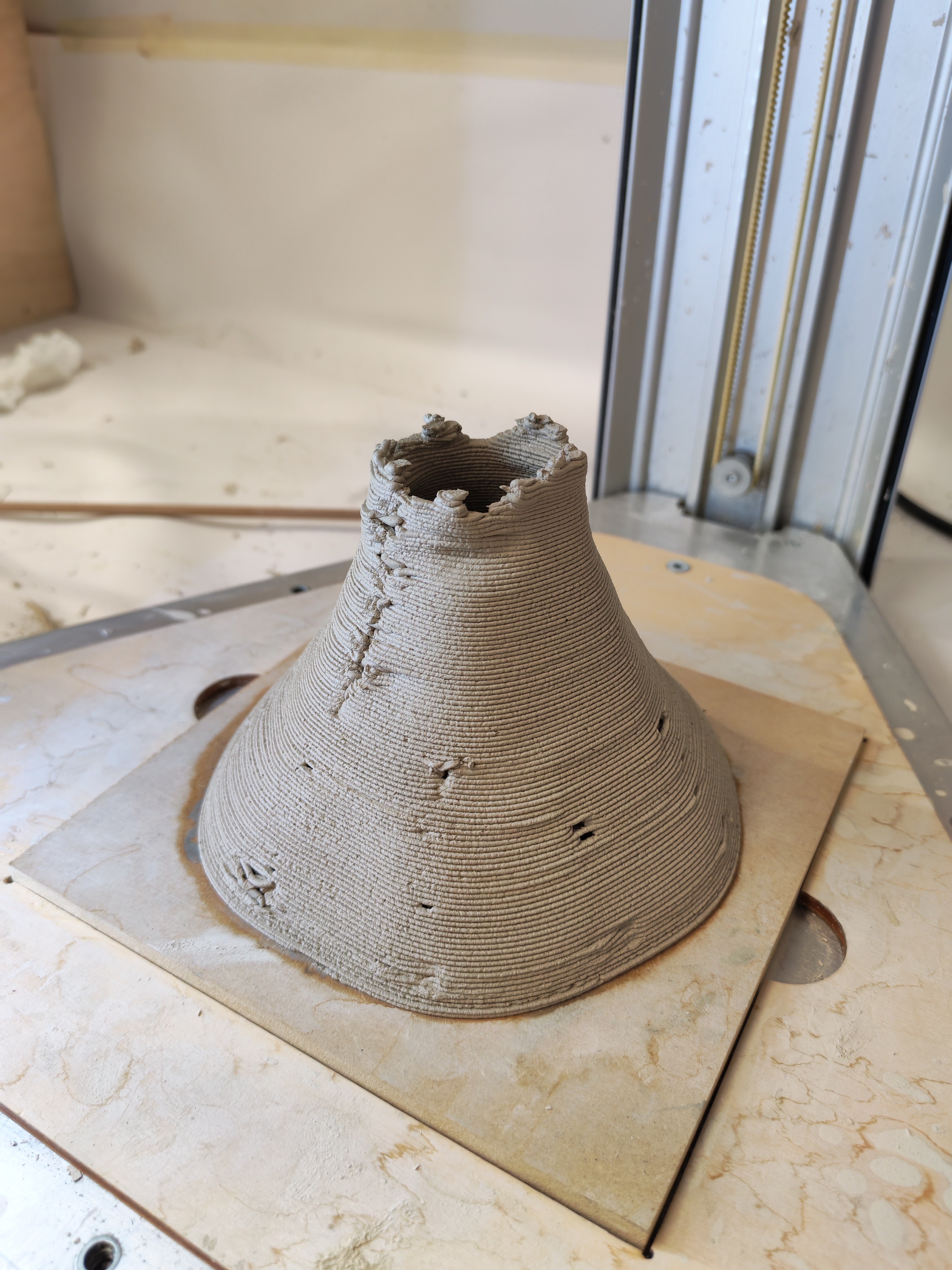
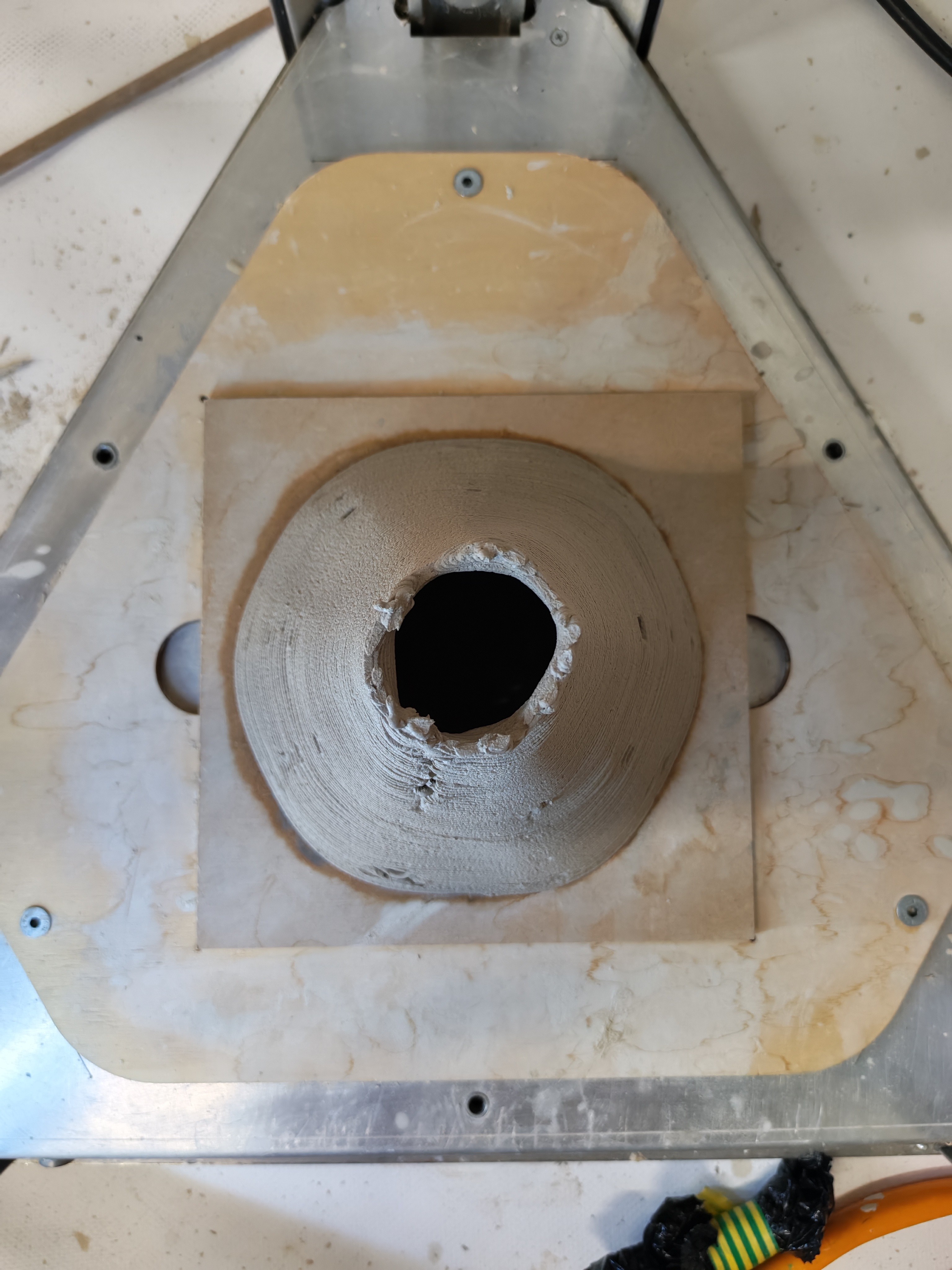
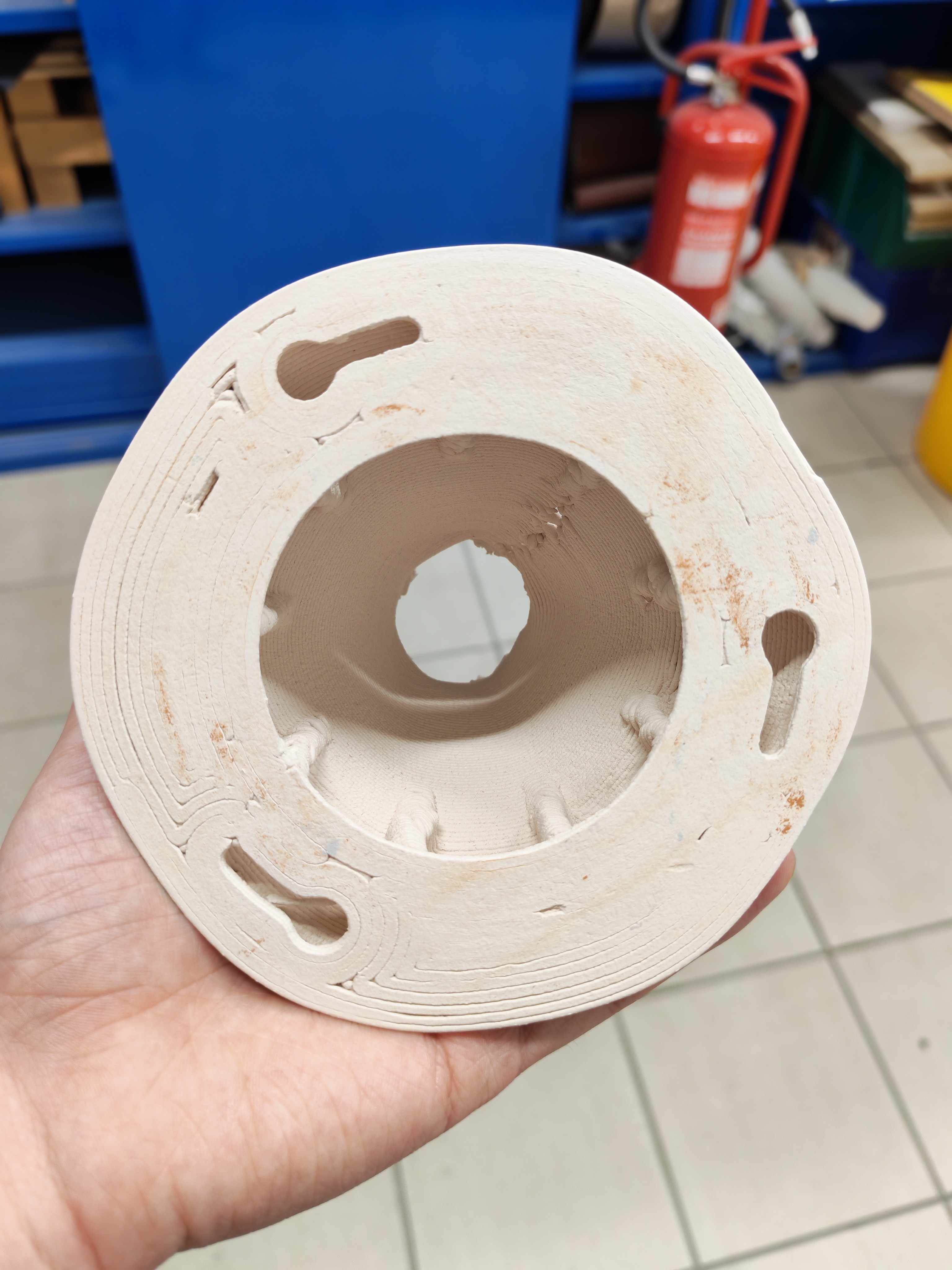
Once I found a satisfactory shape, I exported the STL from Blender and re-imported everything into Fusion to add the base and prepare the file for printing. After a failed print attempt, I added nine internal ribs, which are key to preventing the structure from collapsing and distributing the weight in the steepest points.
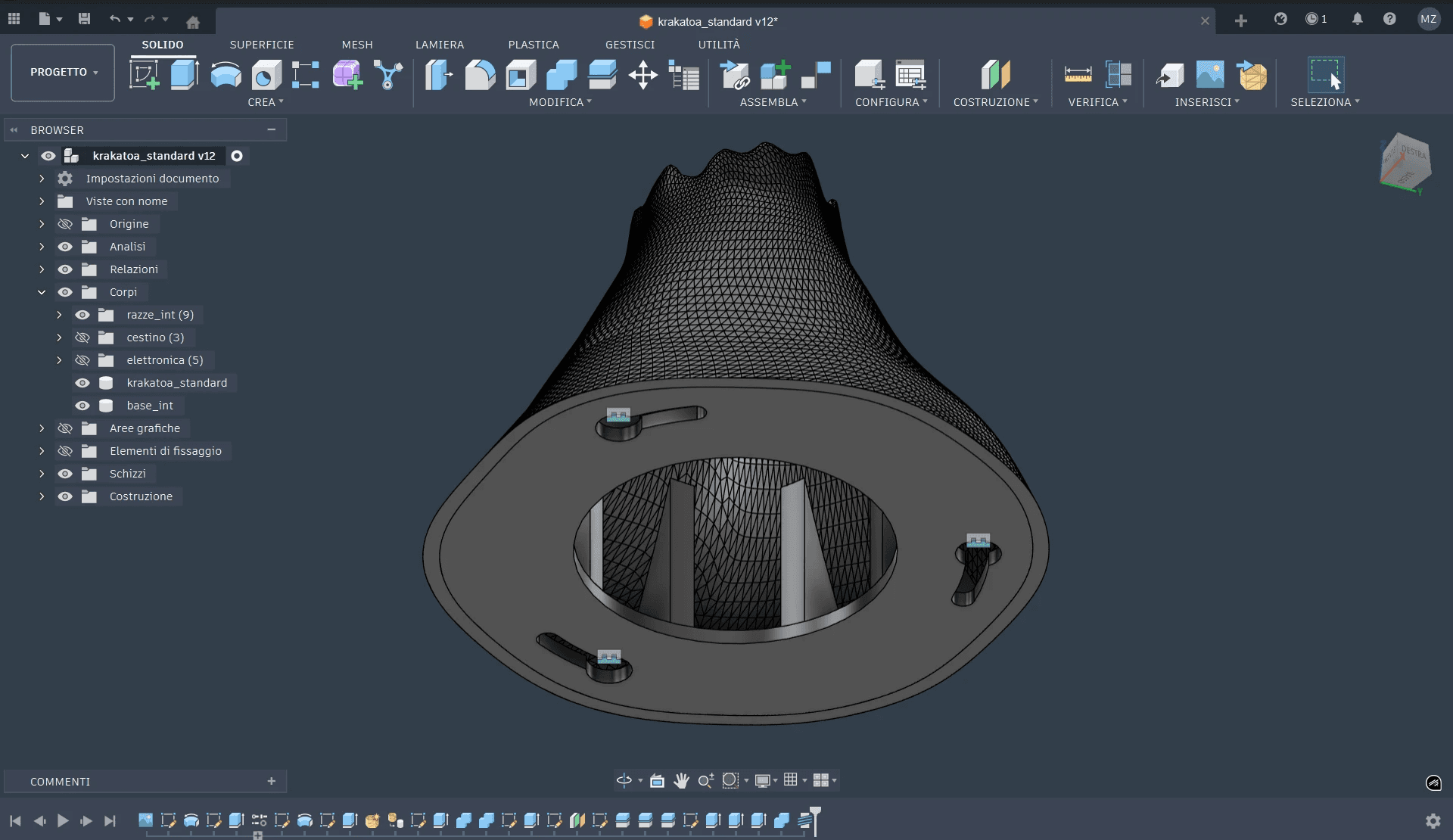
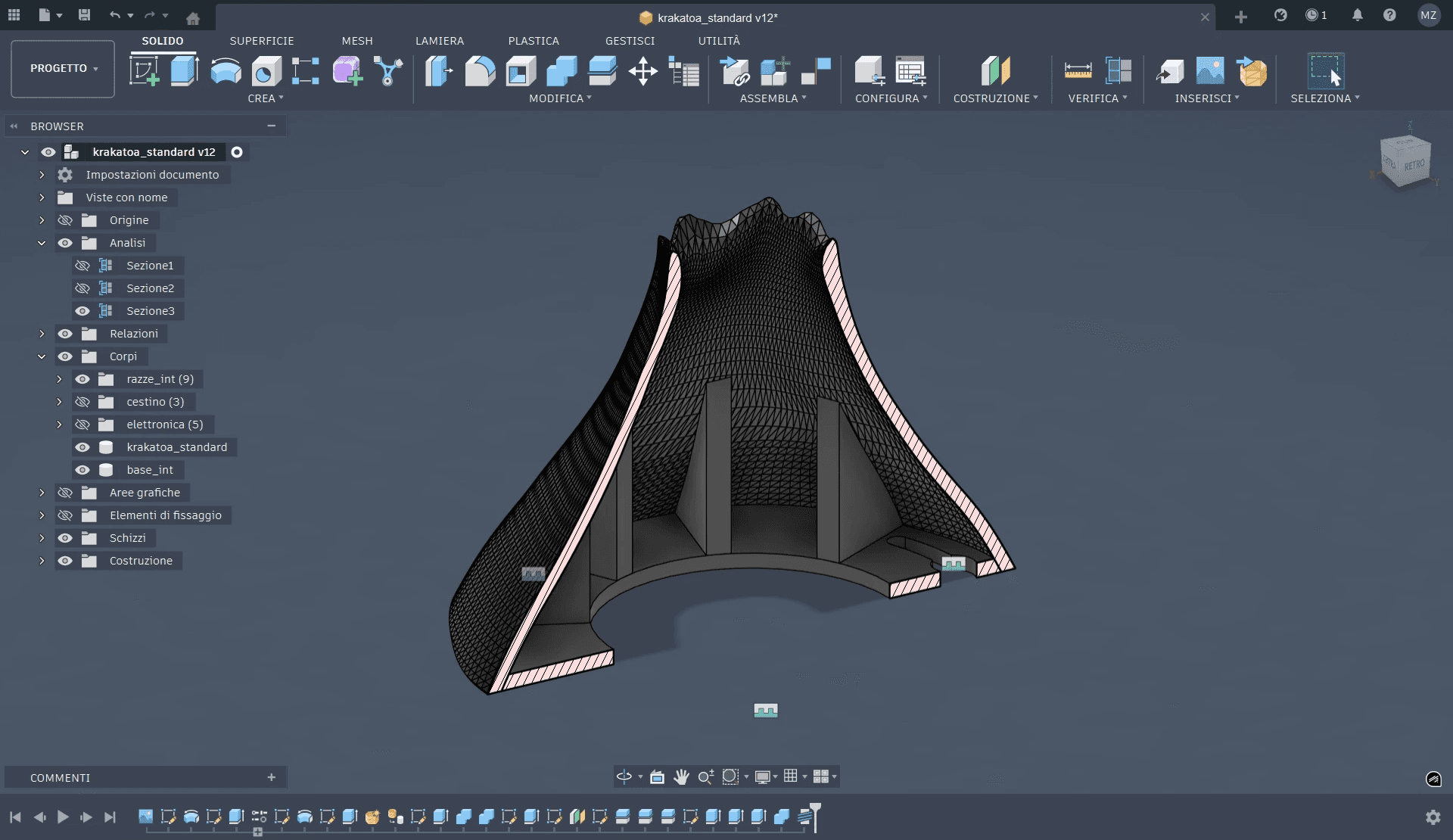
Once I found a satisfactory shape, I exported the STL from Blender and re-imported everything into Fusion to add the base and prepare the file for printing. After a failed print attempt, I added nine internal ribs, which are key to preventing the structure from collapsing and distributing the weight in the steepest points.

Prototyping

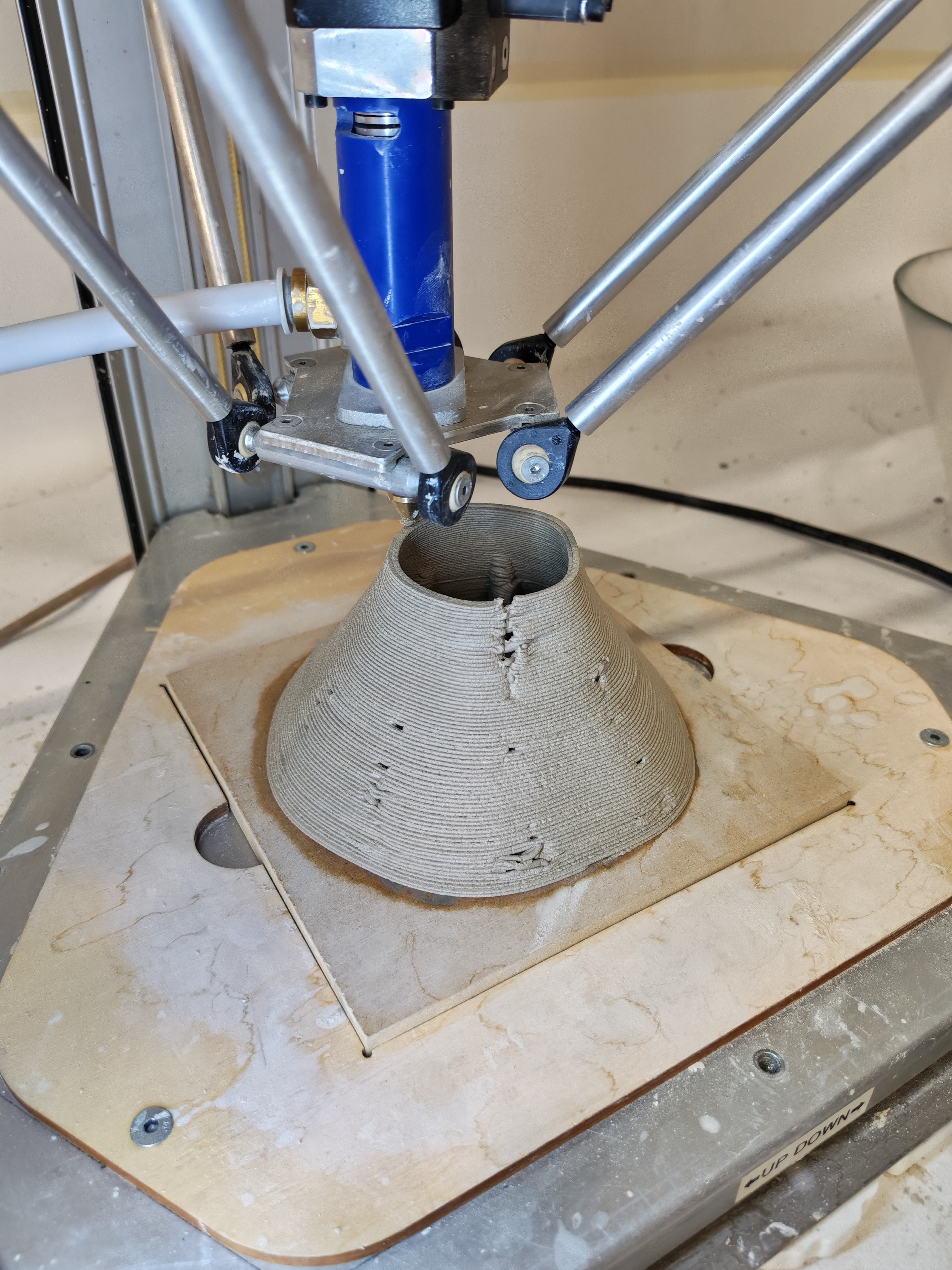
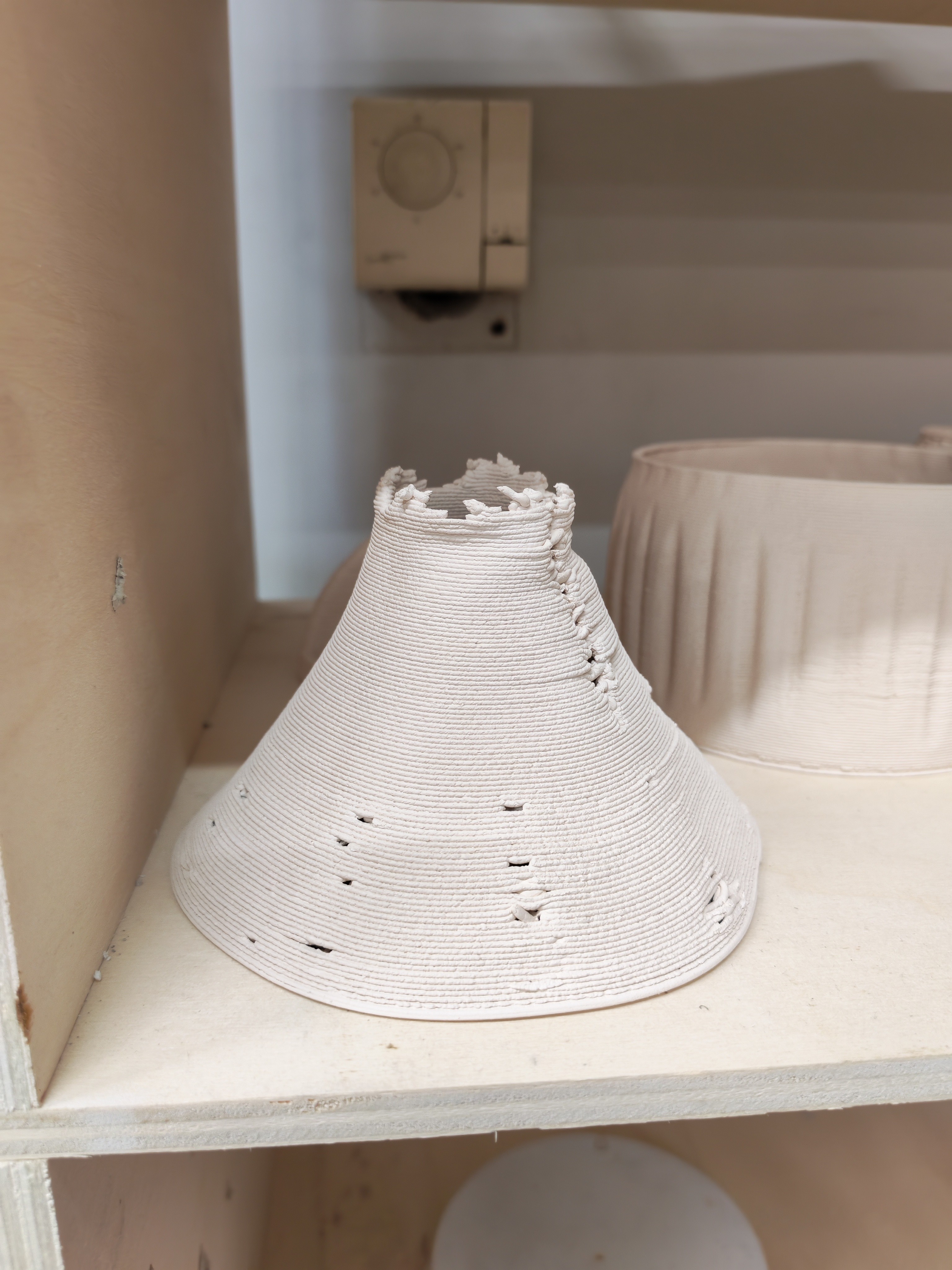
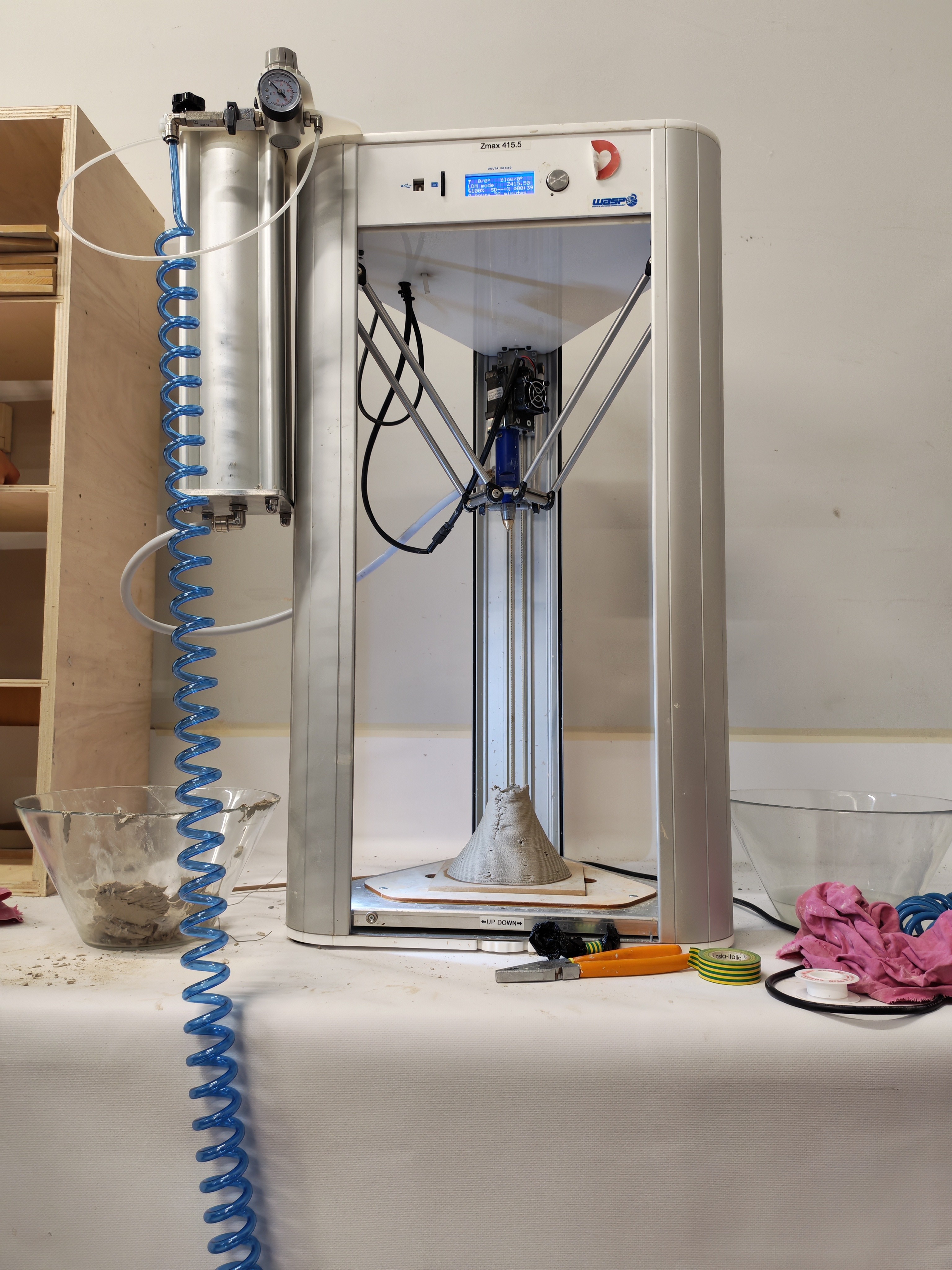
On the second attempt, Krakatoa was printed in LDM, left to dry, and glazed to crystallize. The model is 1:1.9 scale due to the size of the printer's bed.
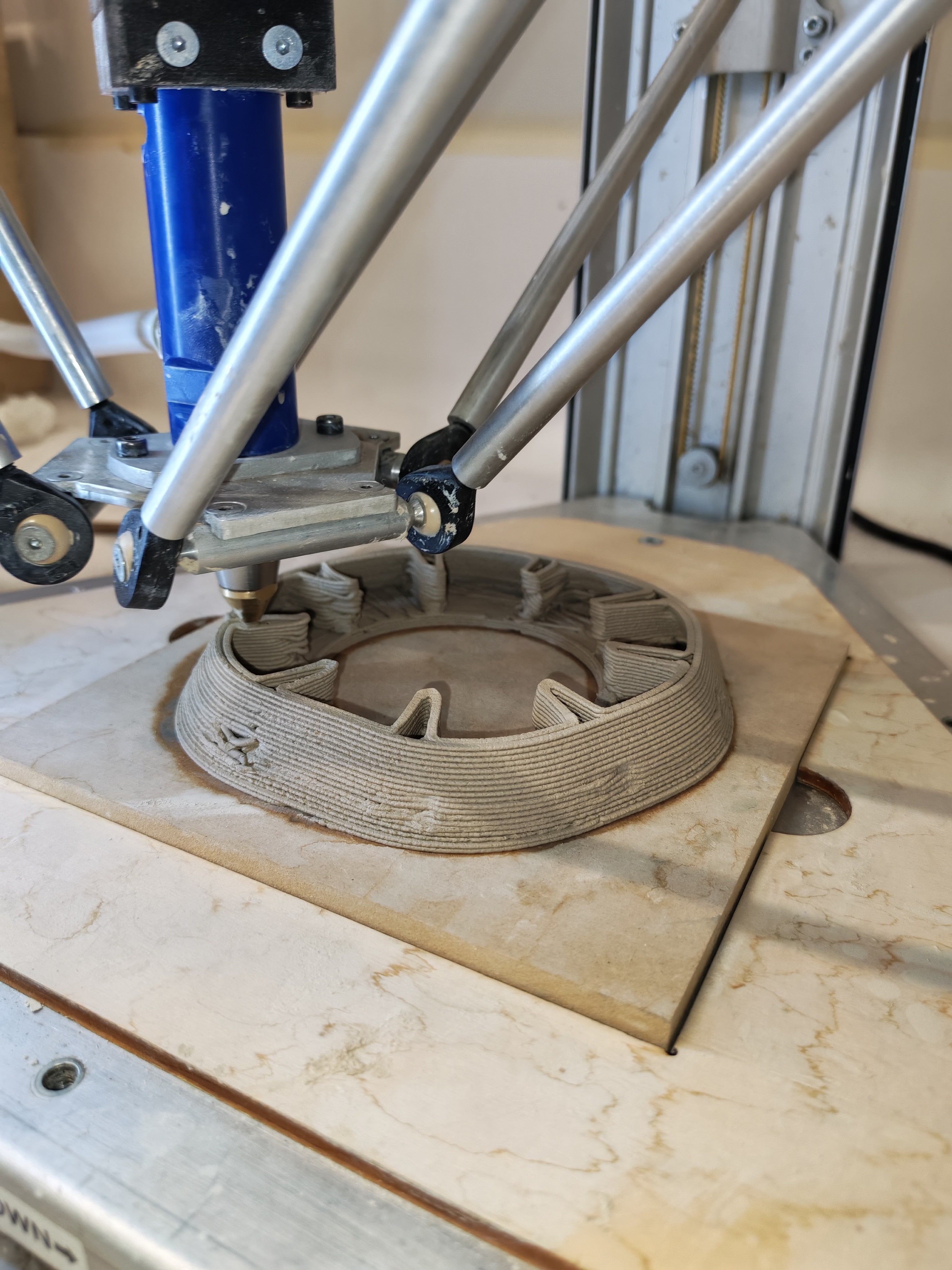
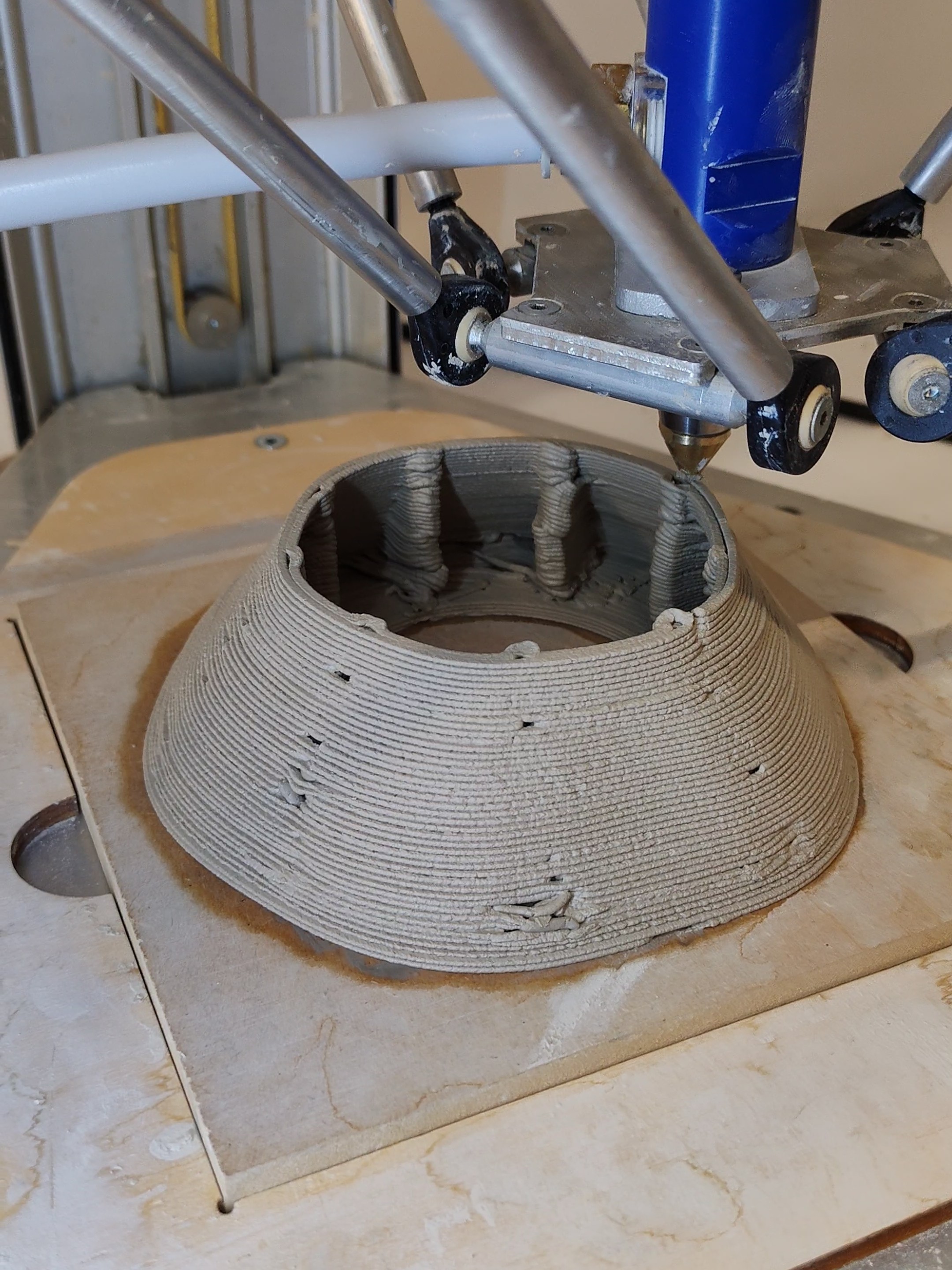
Printing

  • The lamp is designed for a 3 mm nozzle.

  • The shell hides nine internal ribs, which distribute the weight and prevent the "cone" structure from collapsing.

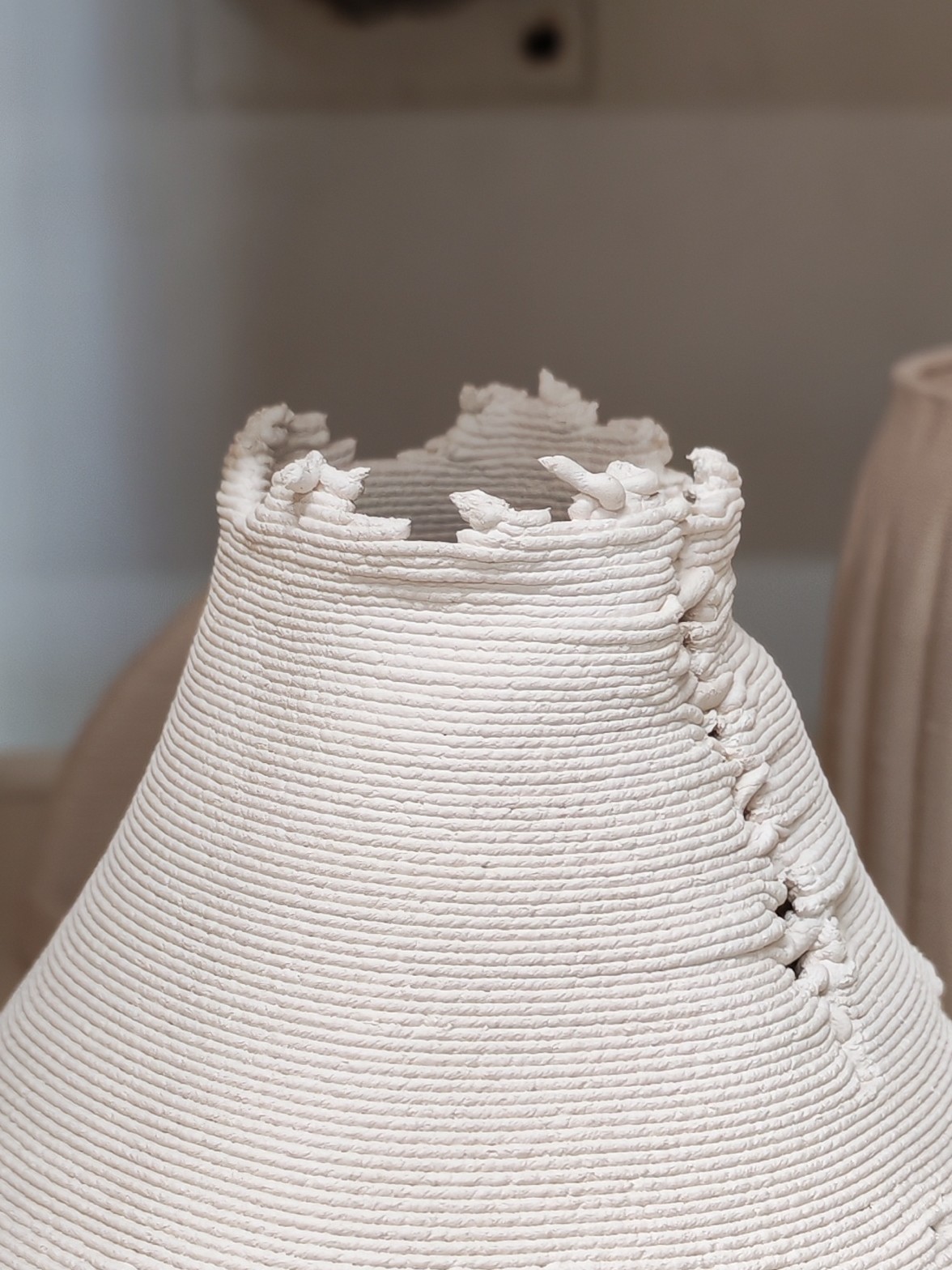
  • Manual refinement of the jagged edges of the crater is required immediately after printing.

CMF

  • Color: Natural whitish mineral tone derived from firing of the material alone, without covering pigments.

  • Material: Gres vitrified at 1220-1250°C to ensure structural strength.

  • Finish: Hybrid aesthetic between the natural porosity of the material and the rhythmic artificiality of the layers. No additional surface treatment.

Final Output

Renders

Image 1
Image 2
Image 3
Image 4
Image 5
Image 6

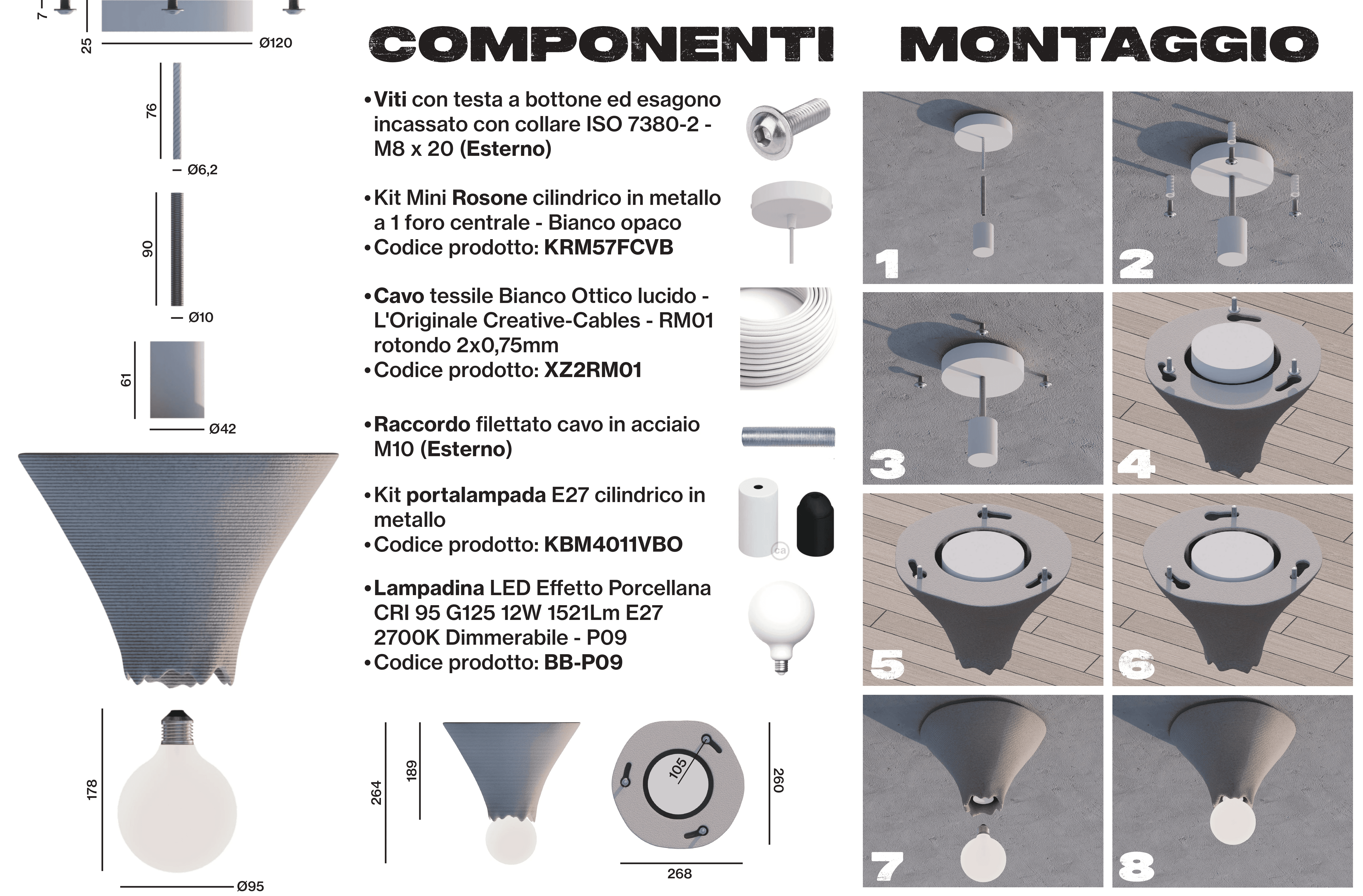
Technical Informations

Final Notes
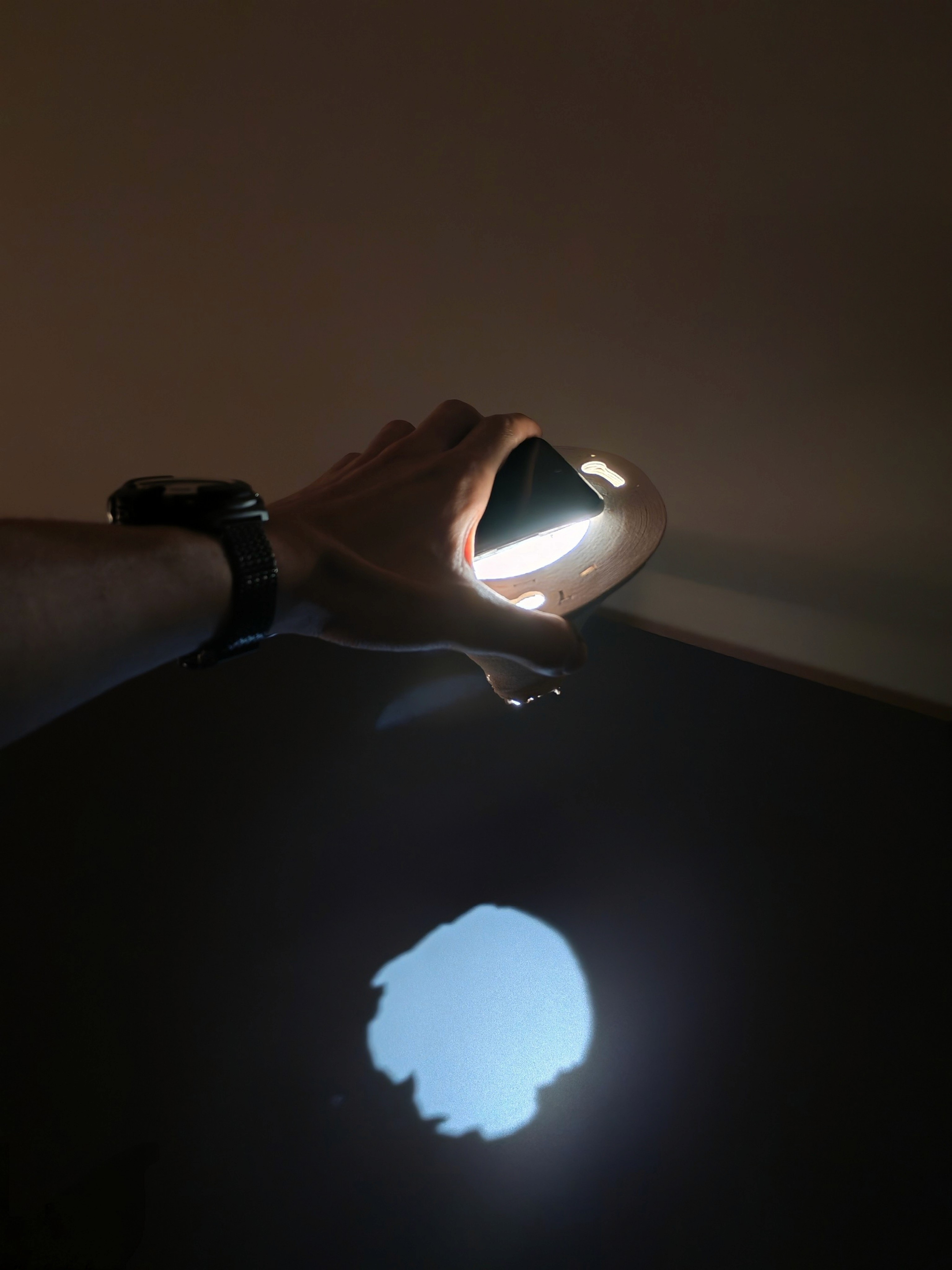
Krakatoa isn't perfect and there's certainly room for improvement:

  • Although the idea was to keep the stoneware untreated, additional study on the ceramic coatings could give added value to the object.

  • I noticed that by replacing the external bulb with a rather intense LED diode, the effect is even more magical: Krakatoa becomes a spotlight that directs light in an irregular shape onto the surface it is pointed at; the light, instead of emerging as a luminous bulb, can literally erupt in the form of a pure beam of light. This is certainly a variation that, breaking away from Creative Cables' academic constraints, could represent a new life for this ever-evolving object.

First steps

I went to a scientific school, so this was the project that introduced me to design for the first time ever and, in part, made me decide to take this carreer path.

Interior design experience

Casa Ariete represents an interior design experience, albeit small, going beyond the canons of Product Design.

Lateral
thinking, spot-
on solutions.

First steps

I went to a scientific school, so this was the project that introduced me to design for the first time ever and, in part, made me decide to take this carreer path.

Interior design experience

Casa Ariete represents an interior design experience, albeit small, going beyond the canons of Product Design.

Morphological reflection exercise

The first activities gave me the chance to think about the shape of an object more than i would normally do during a project.

Digital patterns

I enjoyed generating the patterns and discovering a new graphic vocation, always very useful in any product design project.

Mockups

For both of the phases, I also had the chance to produce many advertising mockups, training me further for the communication part of any project.

Freer view of design

I was able to express myself in a more provocative and playful way, representing a further opportunity for growth as a designer.

Lateral
thinking, spot-
on solutions.

Morphological reflection exercise

The first activities gave me the chance to think about the shape of an object more than I would normally do during a project.

Digital patterns

I enjoyed generating the patterns and discovering a new graphic vocation, always very useful in any product design project.

Mockups

For both of the phases, I also had the chance to produce many advertising mockups, training me further for the communication part of any project.

Freer view of design

I was able to express myself in a more provocative and playful way, representing a further opportunity for growth as a designer.

Digital illustrations

The need to create explicative slides for each milestone of the project allowed me to enhance my illustration skills with the drawing tablet.

Applied interviews

Even if conducted on a small scale, the interviews were crucial for concept generation and an opportunity to improve my user's study skills.

Group catalyst

During the project, I acted as a catalyst in the group dialogue, proposing the design vision that was then selected for the final execution phase.

Sustainably-driven project

Otto's sustainable nature has proven to be its real advantage: it is as simple to use as electronic shredders, but more tactile and gratifying, and has no load limits.

Lateral
thinking, spot-
on solutions.

Digital illustrations

The need to create explicative slides for each milestone of the project allowed me to enhance my illustration skills with the drawing tablet.

Applied interviews

Even if conducted on a small scale, the interviews were crucial for concept generation and an opportunity to improve my user's study skills.

Group catalyst

During the project, I acted as a catalyst in the group dialogue, proposing the design vision that was then selected for the final execution phase.

Sustainably-driven project

Otto's sustainable nature has proven to be its real advantage: it is as simple to use as electronic shredders, but more tactile and gratifying, and has no load limits.

Never seen collaboration with the company

Being so close to the company during the design process encouraged me to get involved, ask questions to experts, and learn as much as possible about ceramics.

Management role

During the design process, I often found myself taking on roles related to the project's identity, research, dialogue with more experienced people in the sector, and product presentation.

Lateral
thinking, spot-
on solutions.

Never seen collaboration with the company

Being so close to the company during the design process encouraged me to get involved, ask questions to experts, and learn as much as possible about ceramics.

Management role

During the design process, I often found myself taking on roles related to the project's identity, research, dialogue with more experienced people in the sector, and product presentation.

Lateral
thinking, spot-
on solutions.

10

Total Projects

5

Selected Projects

3

Companies Involved

1

Fuorisalone Showcase