New social role
Active involvement in the Fondazione Trentina per l'Autismo organization, where I could actually interact with the client.
Metadesign approach
Producing an advanced and plausible concept as a result, without focusing on manufacturability aspects.
Professional organizational tools
First personal use of Dataviz (Matrix, Venn Diagram) and other concept generation tools (Crazy Eight, Personas, Journey Map, Tier Lists).
Pysical models over drawings
The project development was mostly based on study models, wich eventually evolved into the final prototypes.
Lateral
thinking, spot-
on solutions.


New social role
Active involvement in the Fondazione Trentina per l'Autismo organization, where I could actually interact with the client.
Metadesign approach
Producing an advanced and plausible concept as a result, without focusing on manufacturability aspects.
Professional organizational tools
First personal use of Dataviz (Matrix, Venn Diagram) and other concept generation tools (Crazy Eight, Personas, Journey Map, Tier Lists).
Physical models over drawings
The project development was mostly based on study models, wich eventually evolved into the final prototypes.
Redescovering simplicity
Very often, this job leads to unnecessary complications. In this case, I rediscovered the value of simple objects, supported by strong concepts.
Thinking with hands
This project also confirmed my preference for producing physical models to propose ideas during the development phase, rather than drawings.
Back to the origins
I discovered a new aspect of design: the artisanal one, made of sweat and sawdust, with the priceless satisfaction of using a self-produced object on a daily basis.
Lateral
thinking, spot-
on solutions.
Rediscovering simplicity
Very often, this job leads to unnecessary complications. In this case, I rediscovered the value of simple objects, supported by strong concepts.
Thinking with hands
This project confirmed my preference for producing physical models to propose ideas during the development phase, rather than drawings.
Back to the origins
I discovered a new aspect of design: the artisanal one, made of sweat and sawdust, with the priceless satisfaction of using a self-produced object on a daily basis.
Importance of history
Rediscovering Cisitalia taught me the importance of curiosity and research in every project.
Formal reinterpretation
This project trained me for a common challenge in the design industry: the formal rebranding in search for a new corporate identity.
3D modeling
The project gave me the opportunity to delve deeper into parametric surface modeling, using an unconventional software: ZW3D.
Hunger for improvement
This experience left me with the desire to improve my rendering and 3D printing skills, which I actually refined in subsequent projects.
Lateral
thinking, spot-
on solutions.


Importance of history
Rediscovering Cisitalia taught me the importance of curiosity and research in every project.
Formal reinterpretation
This project trained me for a common challenge in the design industry: the formal rebranding in search for a new corporate identity.
3D modeling
The project gave me the opportunity to delve deeper into parametric surface modeling, using an unconventional software: ZW3D.
Hunger for improvement
This experience left me with the desire to improve my rendering and 3D printing skills, which I actually refined in subsequent projects.
Role of poetry
The relationship between light and ceramic material is common to all of the concepts. I am more convinced than ever of the importance of poetry in the designer's craft.
Importance of mistakes
Krakatoa is the result of a great deal of trial and error, from which I've always drawn something new. I believe that this is fundamental in a designer's career.
Boost on drawingss
This is a project that required a lot of sketching. This gave me the opportunity to refine this aspect of design and better define my style.
New softwares
Designing Krakatoa gave me the chance to deepen my knowledge of Fusion 360 and start using Blender for organic shapes and renderings.
In search of perfection
This project taught me more than any other to never stop at the first idea and be willing to start over, revolutionize an idea in search of the best possible result.
Lateral
thinking, spot-
on solutions.


Role of poetry
The relationship between light and ceramic material is common to all of the concepts. I am more convinced than ever of the importance of poetry in the designer's craft.
Importance of mistakes
Krakatoa is the result of a great deal of trial and error, from which I've always drawn something new. I believe that this is fundamental in a designer's career.
Boost on drawings
This is a project that required a lot of sketching. This gave me the opportunity to refine this aspect of design and better define my style.
New softwares
Designing Krakatoa gave me the chance to enrich my knowledge of Fusion 360 and start using Blender for organic shapes and renderings.
In search of perfection
This project taught me more than any other to never stop at the first idea and be willing to start over, revolutionize an idea in search of the best possible result.
First steps
I went to a scientific school, so this was the project that introduced me to design for the first time ever and, in part, made me decide to take this carreer path.
Interior design experience
Casa Ariete represents an interior design experience, albeit small, going beyond the canons of Product Design.
Lateral
thinking, spot-
on solutions.

First steps
I went to a scientific school, so this was the project that introduced me to design for the first time ever and, in part, made me decide to take this carreer path.
Interior design experience
Casa Ariete represents an interior design experience, albeit small, going beyond the canons of Product Design.
Morphological reflection exercise
The first activities gave me the chance to think about the shape of an object more than i would normally do during a project.
Digital patterns
I enjoyed generating the patterns and discovering a new graphic vocation, always very useful in any product design project.
Mockups
For both of the phases, I also had the chance to produce many advertising mockups, training me further for the communication part of any project.
Freer view of design
I was able to express myself in a more provocative and playful way, representing a further opportunity for growth as a designer.
Lateral
thinking, spot-
on solutions.
Morphological reflection exercise
The first activities gave me the chance to think about the shape of an object more than I would normally do during a project.
Digital patterns
I enjoyed generating the patterns and discovering a new graphic vocation, always very useful in any product design project.
Mockups
For both of the phases, I also had the chance to produce many advertising mockups, training me further for the communication part of any project.
Freer view of design
I was able to express myself in a more provocative and playful way, representing a further opportunity for growth as a designer.
Digital illustrations
The need to create explicative slides for each milestone of the project allowed me to enhance my illustration skills with the drawing tablet.
Applied interviews
Even if conducted on a small scale, the interviews were crucial for concept generation and an opportunity to improve my user's study skills.
Group catalyst
During the project, I acted as a catalyst in the group dialogue, proposing the design vision that was then selected for the final execution phase.
Sustainably-driven project
Otto's sustainable nature has proven to be its real advantage: it is as simple to use as electronic shredders, but more tactile and gratifying, and has no load limits.
Lateral
thinking, spot-
on solutions.
Digital illustrations
The need to create explicative slides for each milestone of the project allowed me to enhance my illustration skills with the drawing tablet.
Applied interviews
Even if conducted on a small scale, the interviews were crucial for concept generation and an opportunity to improve my user's study skills.
Group catalyst
During the project, I acted as a catalyst in the group dialogue, proposing the design vision that was then selected for the final execution phase.
Sustainably-driven project
Otto's sustainable nature has proven to be its real advantage: it is as simple to use as electronic shredders, but more tactile and gratifying, and has no load limits.
Otto
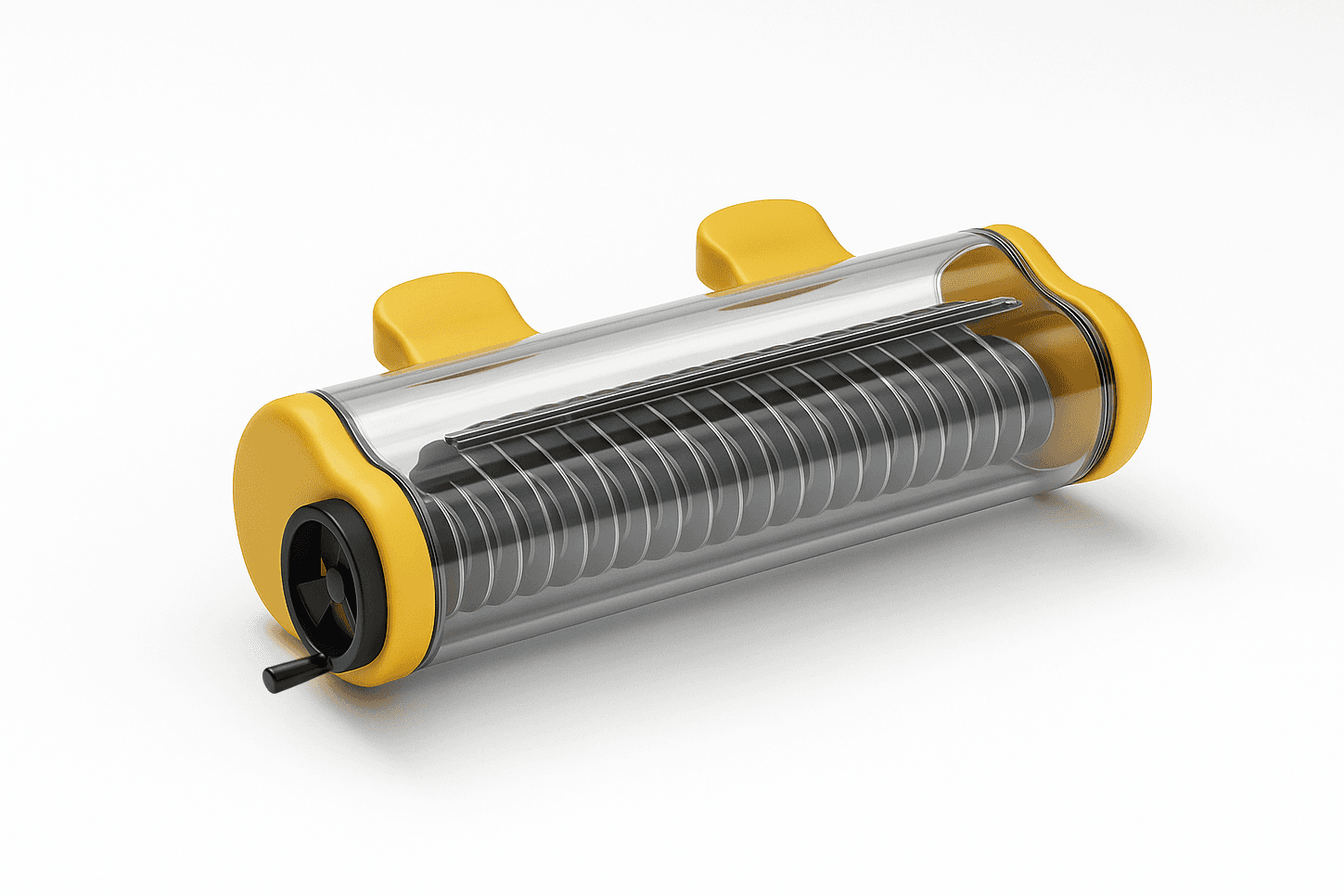
Otto is an analogical paper shredder, attachable to any table thanks to its clamps, born from the need to simplify and make its electronic counterparts on the market more sustainable.
PROJECT LINEUP
Group of five people.
ROLE
Market research, user research, concept generation, illustrative drawings.
BRIEF
Choose an electrical appliance considered over-engineered and simplify it by designing an analogical and sustainable alternative.
NOTES
The project was developed as a group for the Laboratorio di Fondamenti del Progetto (Project's Fundamentals Laboratory).
The final output required was a moderately advanced concept, appropriate for a first-year university student. No physical models or digital renderings were required.
Market Research
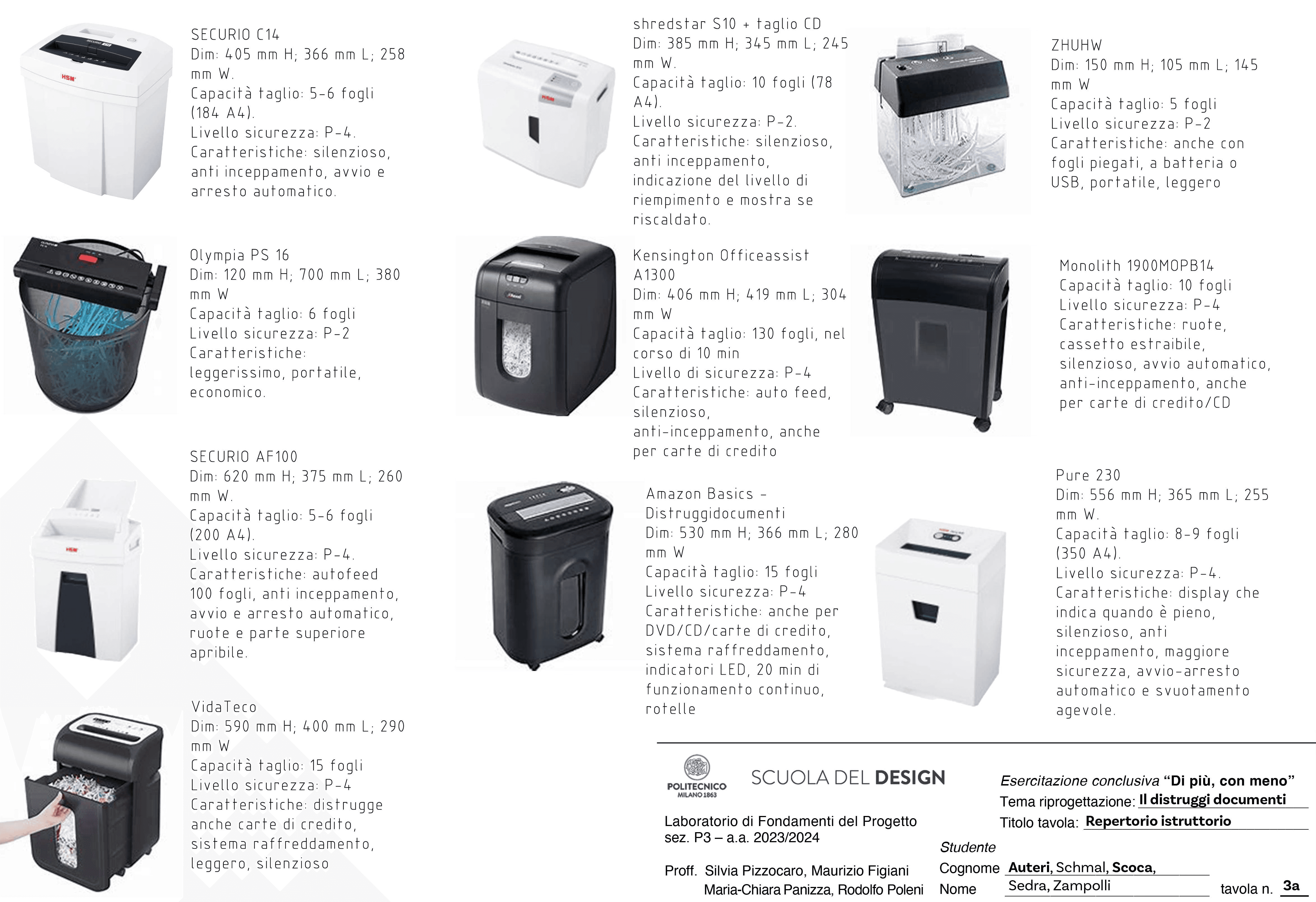
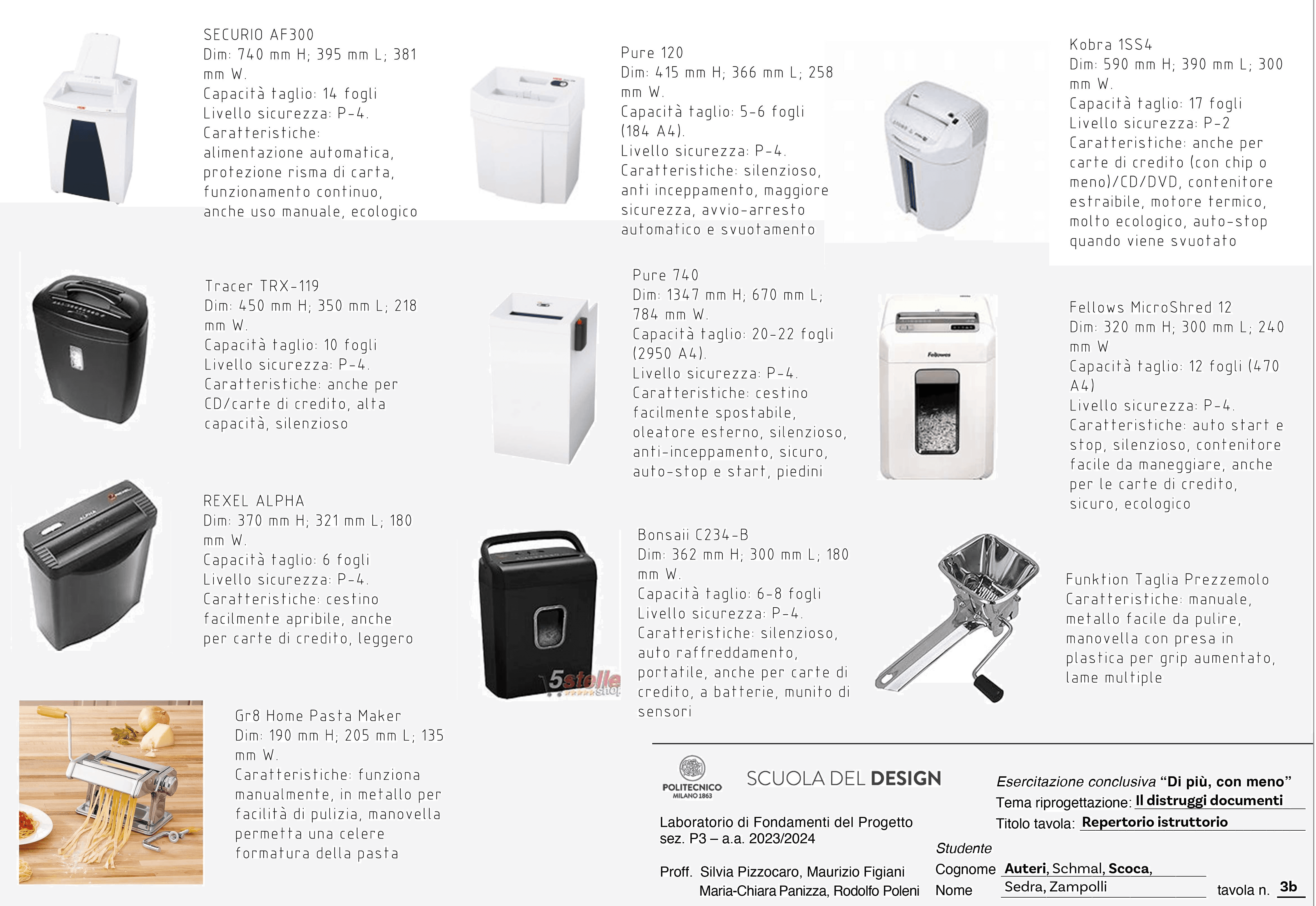
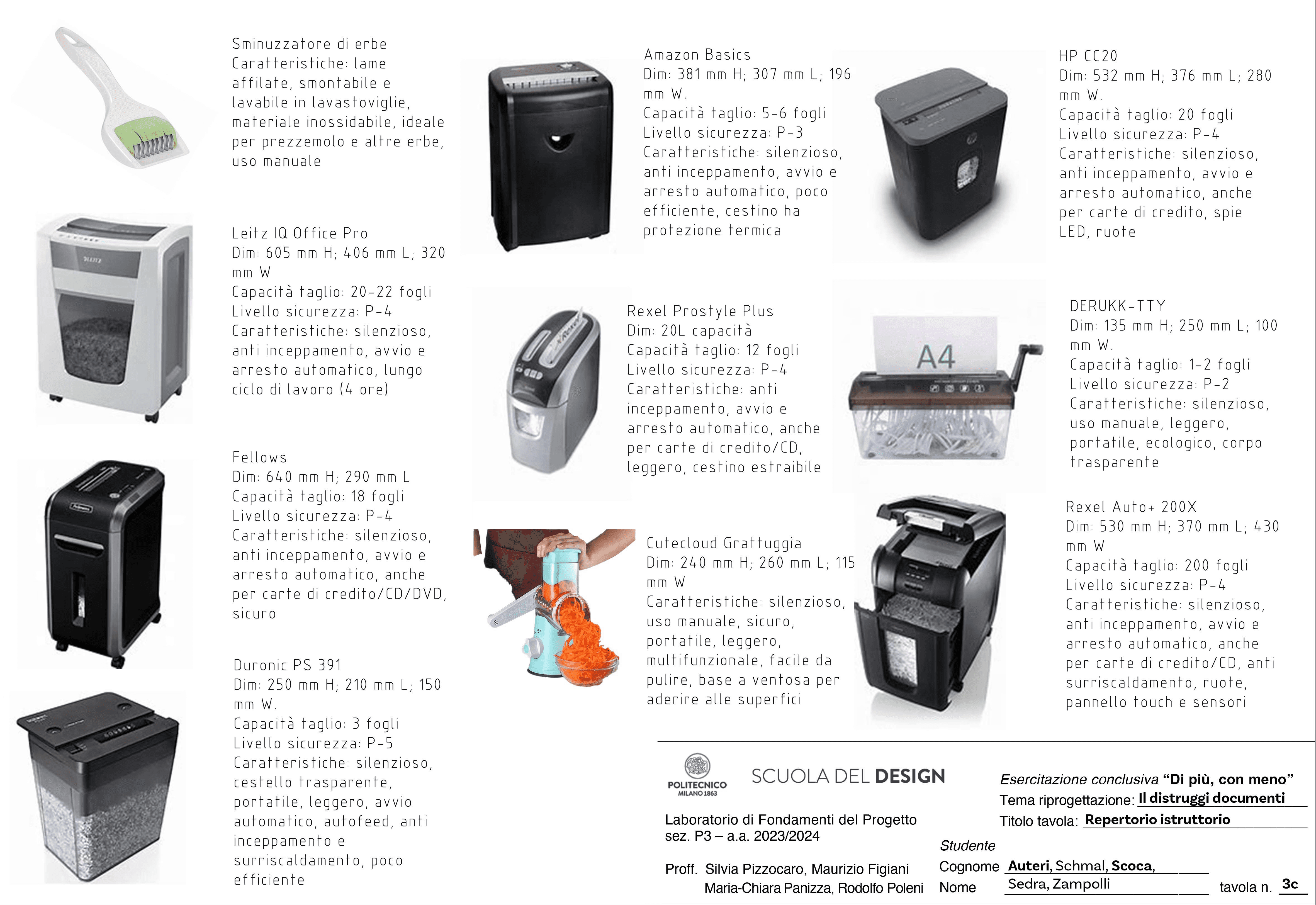
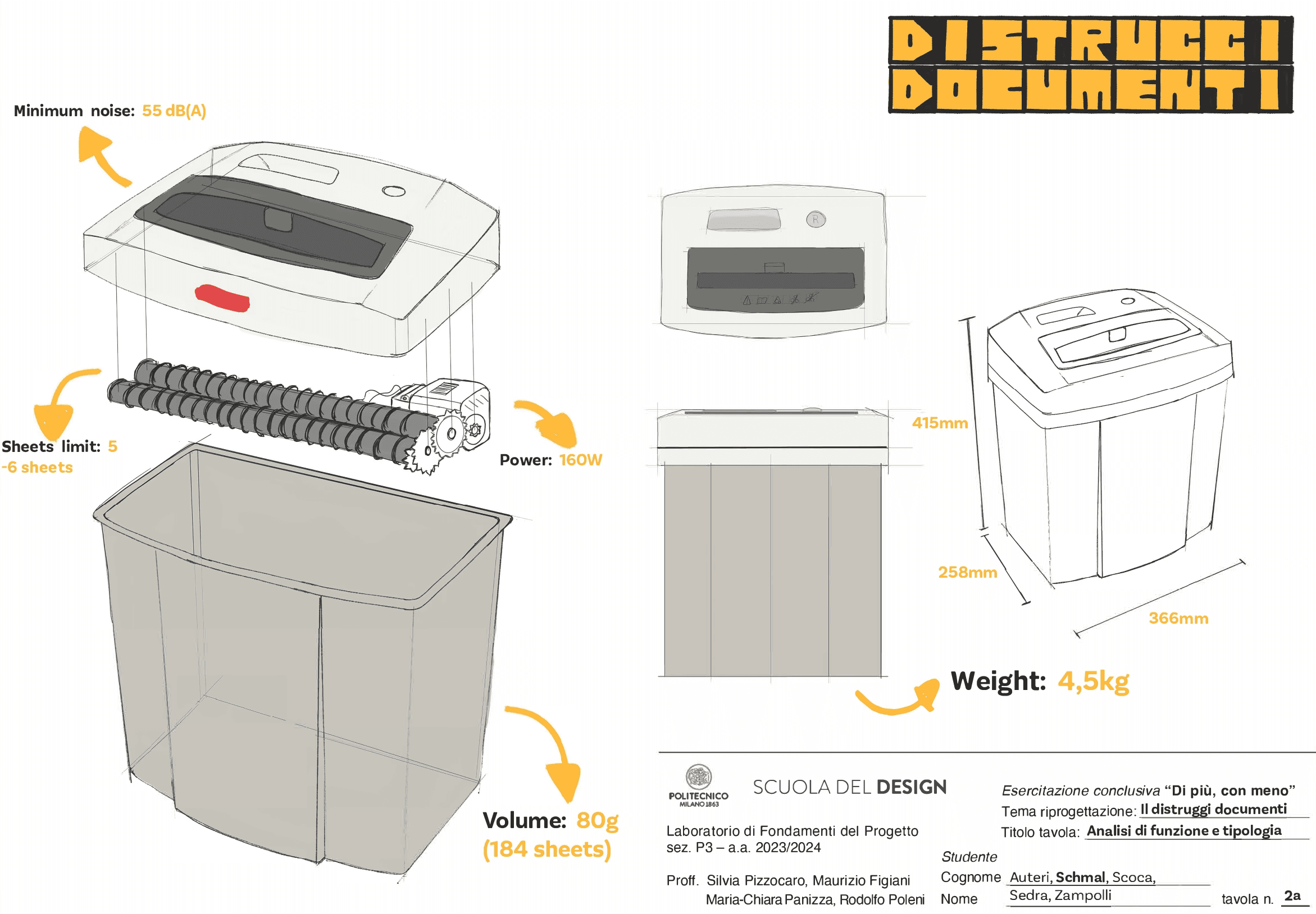
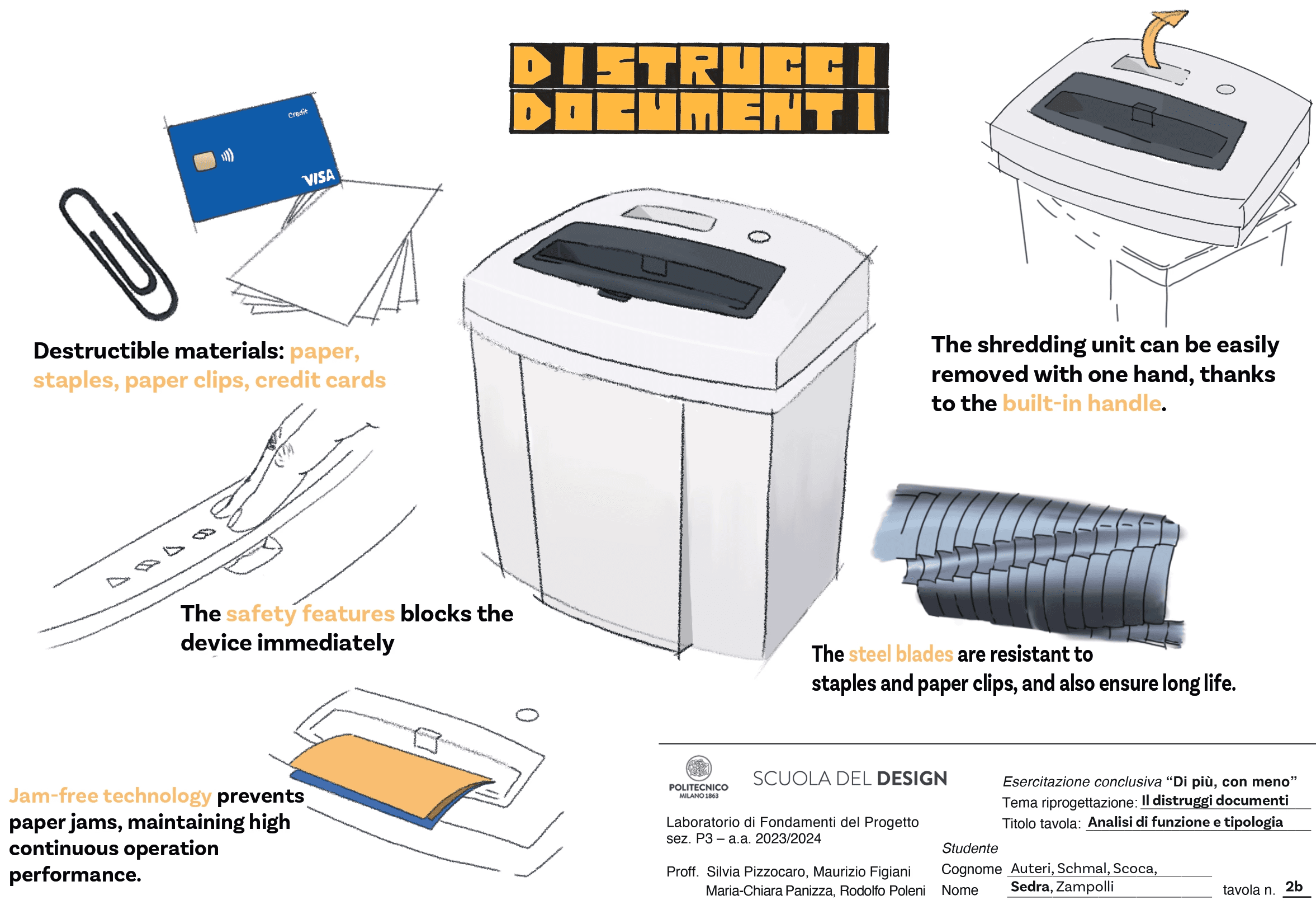
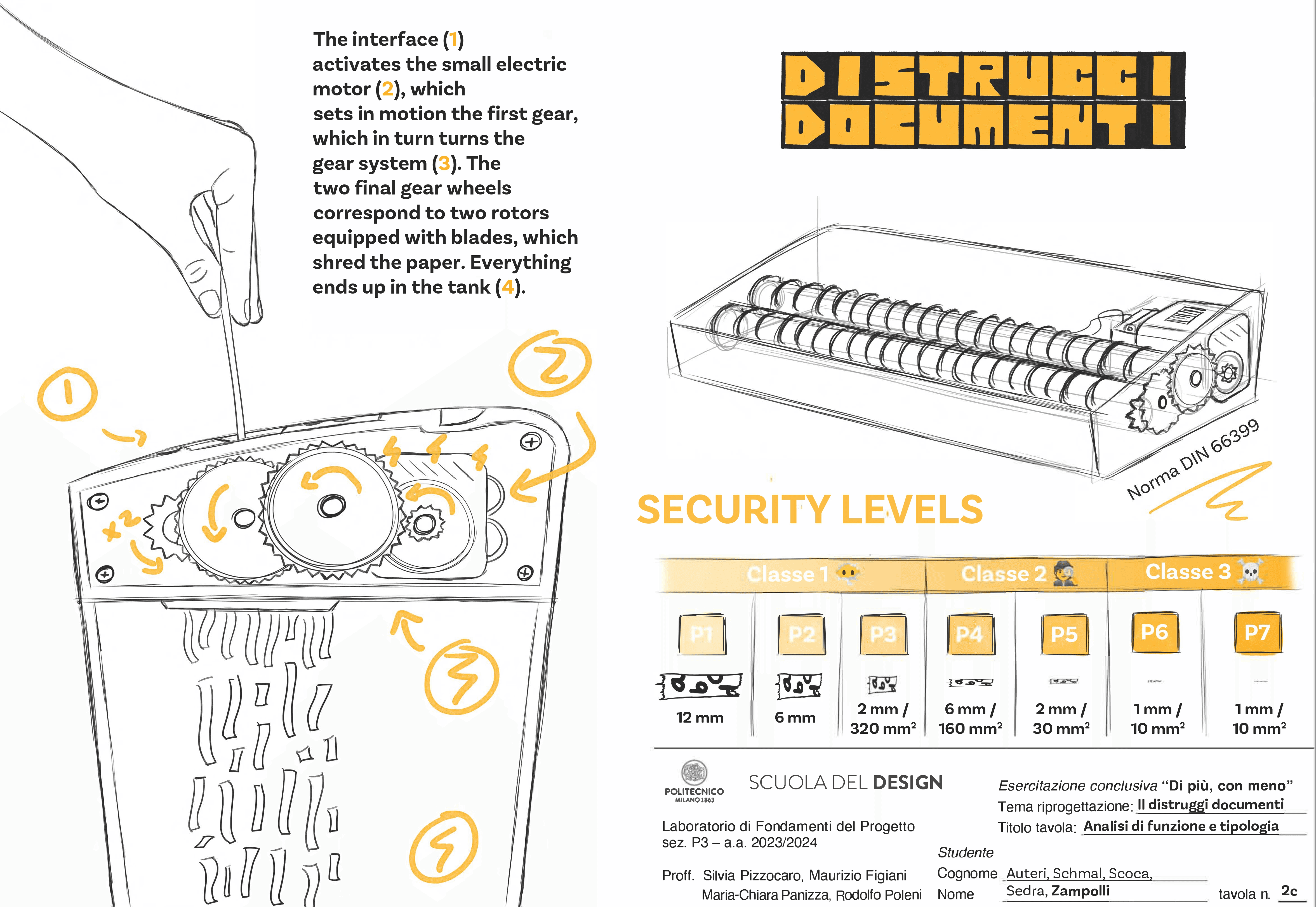
Before proceeding, it was necessary to gain a thorough understanding of the object to be redesigned, analyzing in more detail how a document shredder works and cataloging the various options available on the market.
User Research
The next step was to interview people who were used to using a paper shredder in real life, in their office.
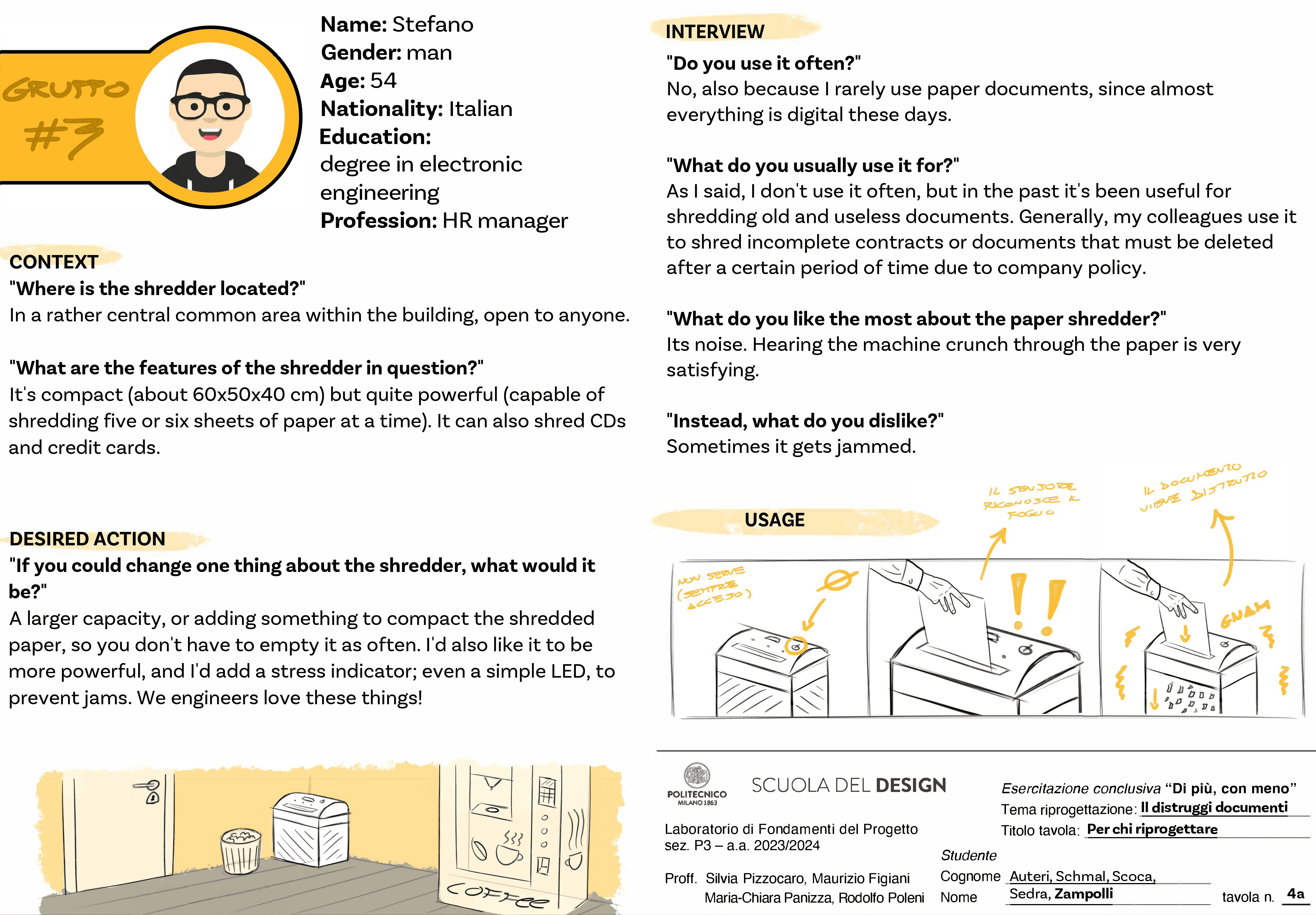
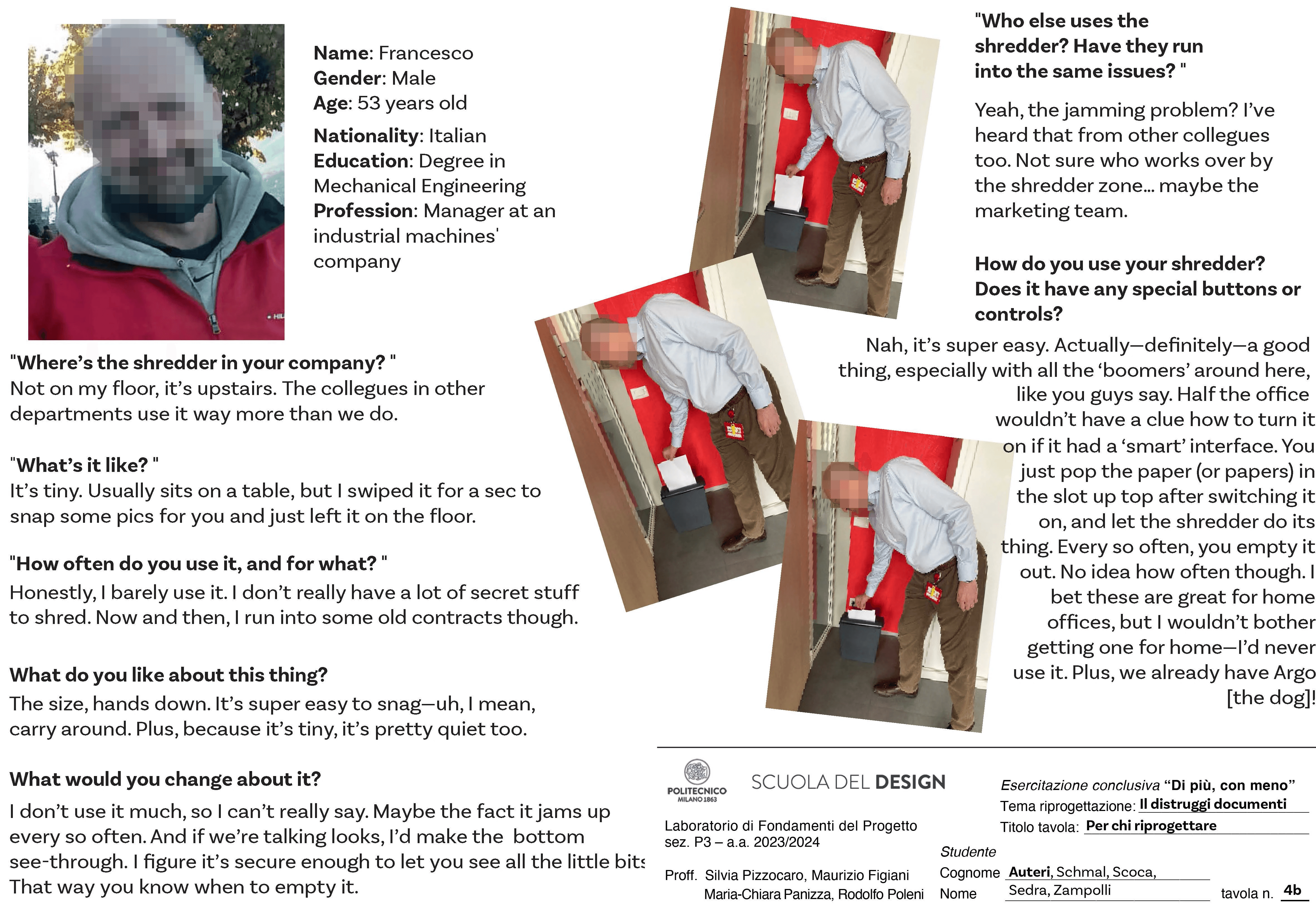
This short interview phase proved to be crucial within the project, because it precisely directed the concept generation phase: designing an object that makes document shredding both sustainable and playful, focusing on the satisfying feedback of paper shredding that emerged right in the interviews.
Concept Generation
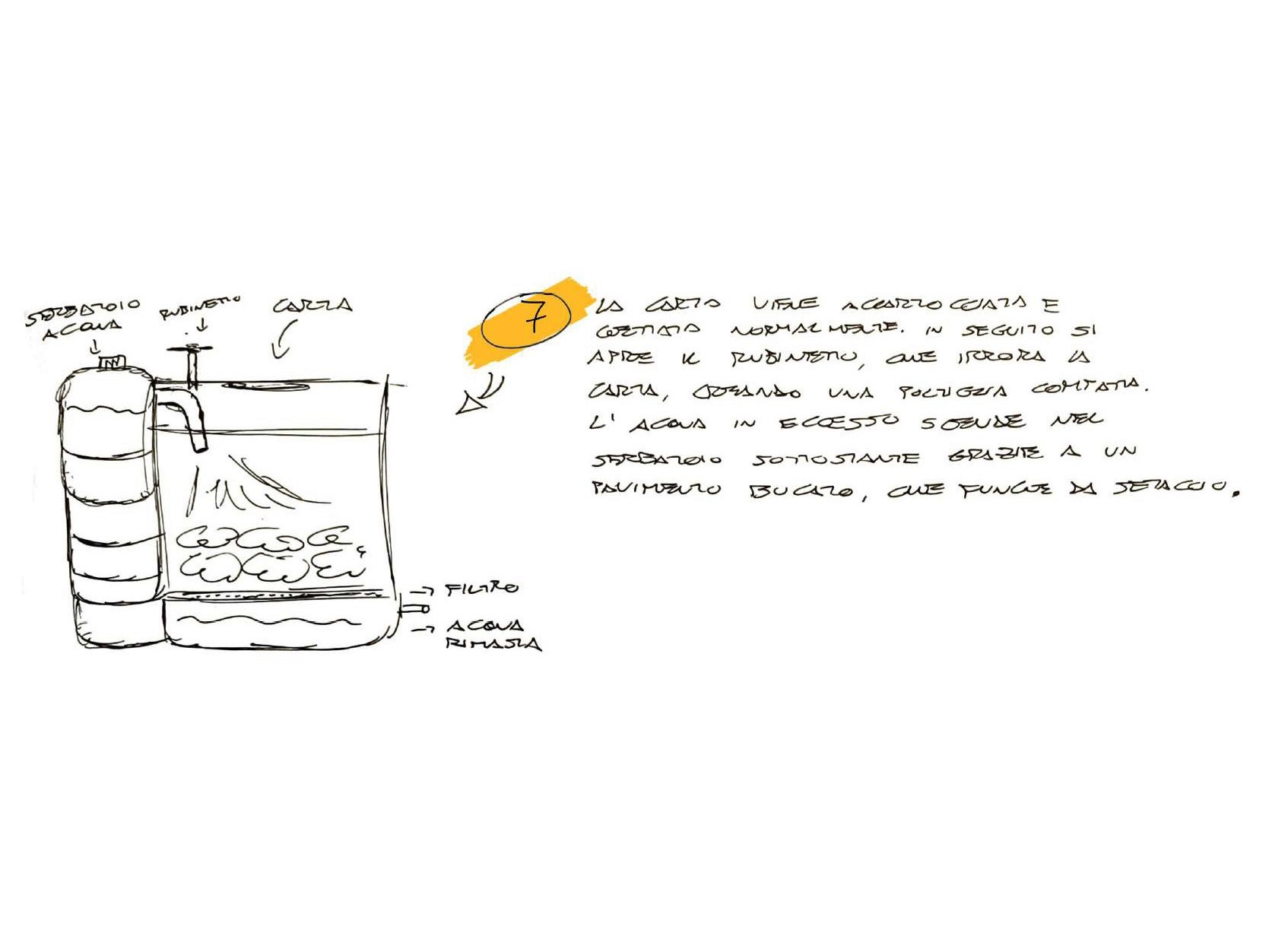
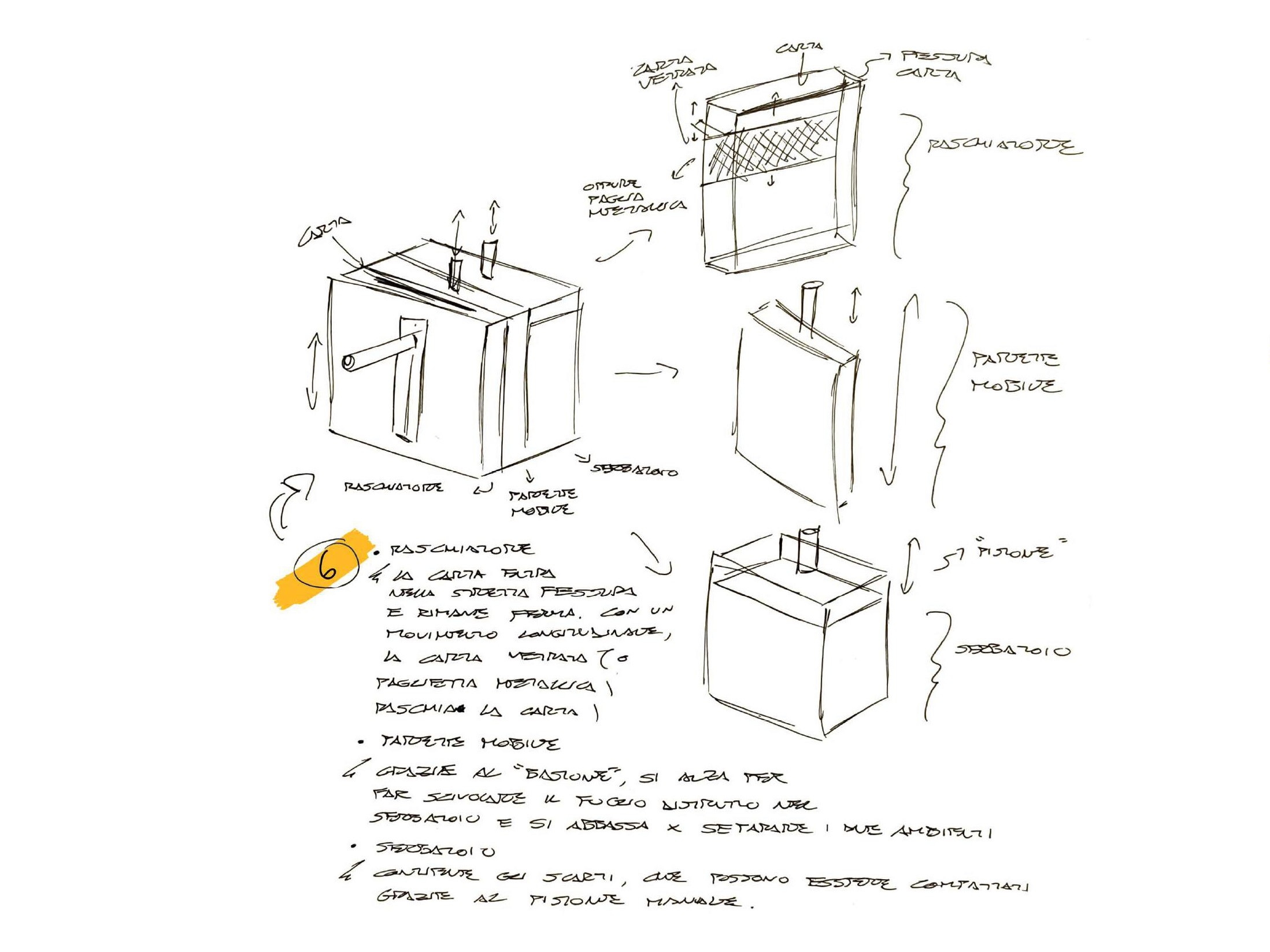
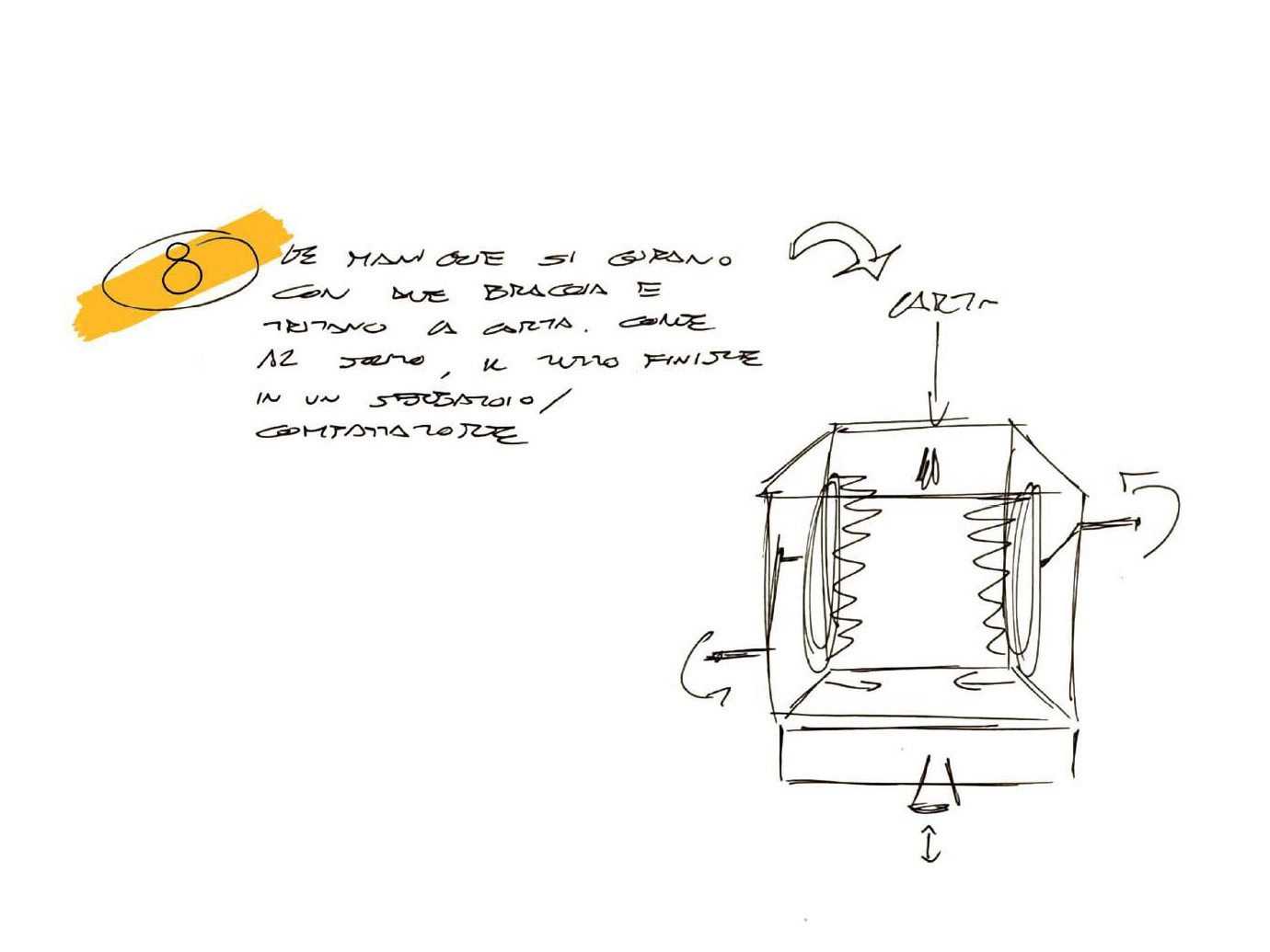
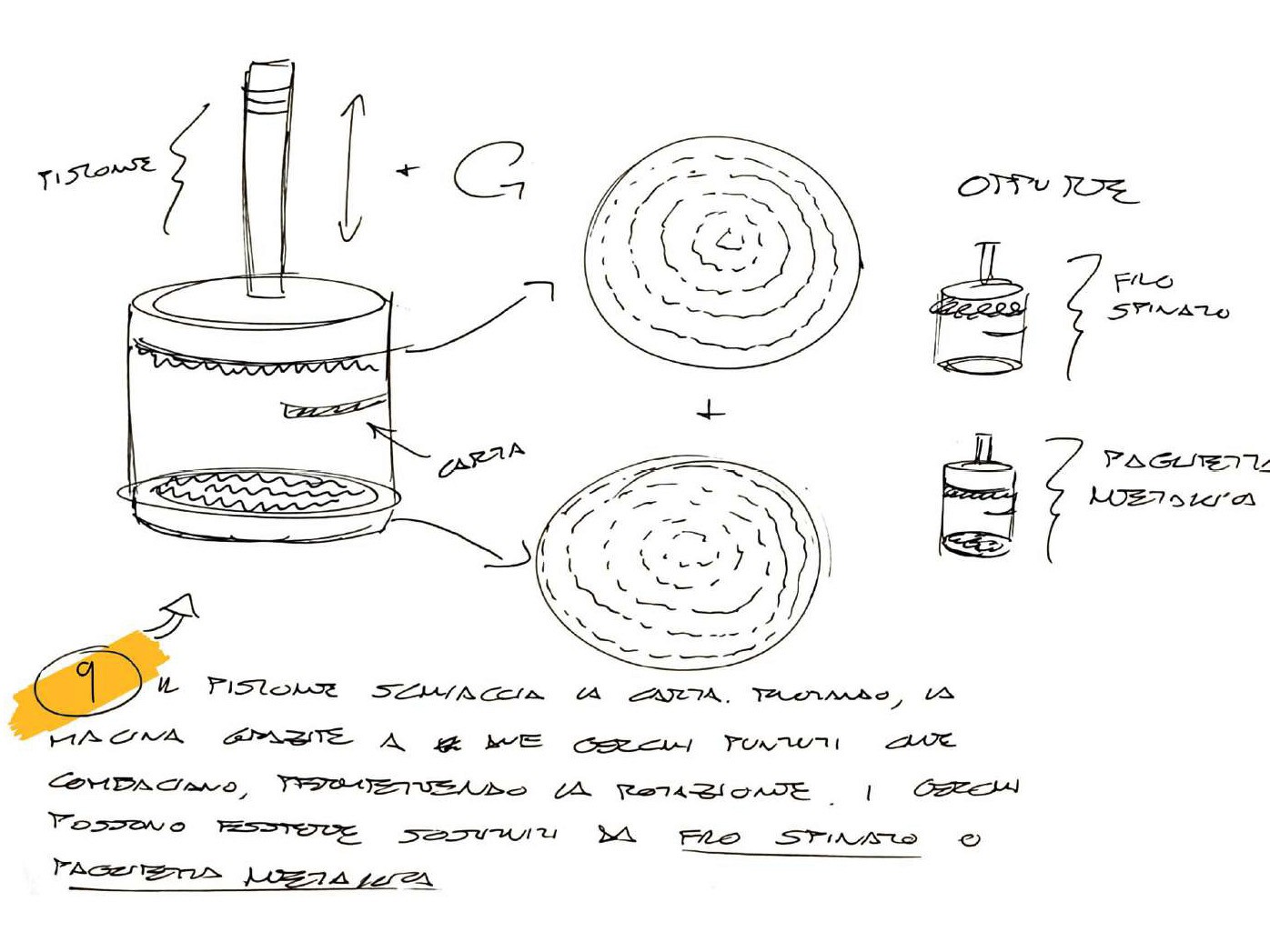
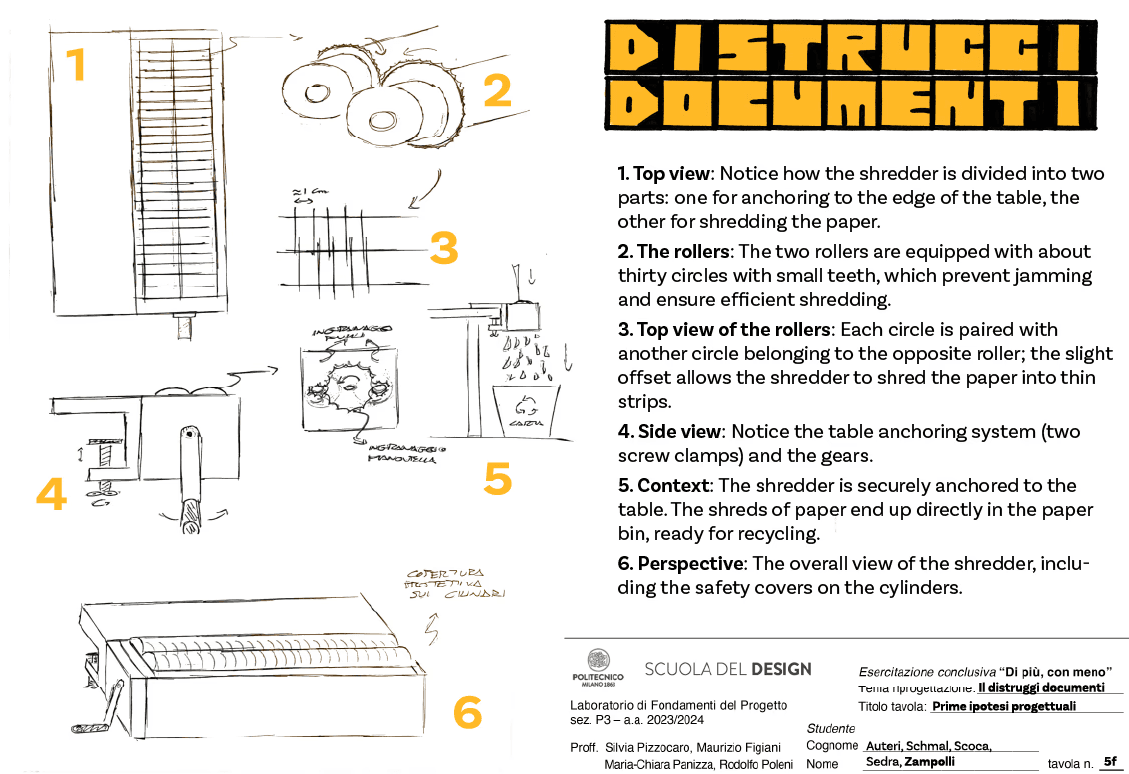
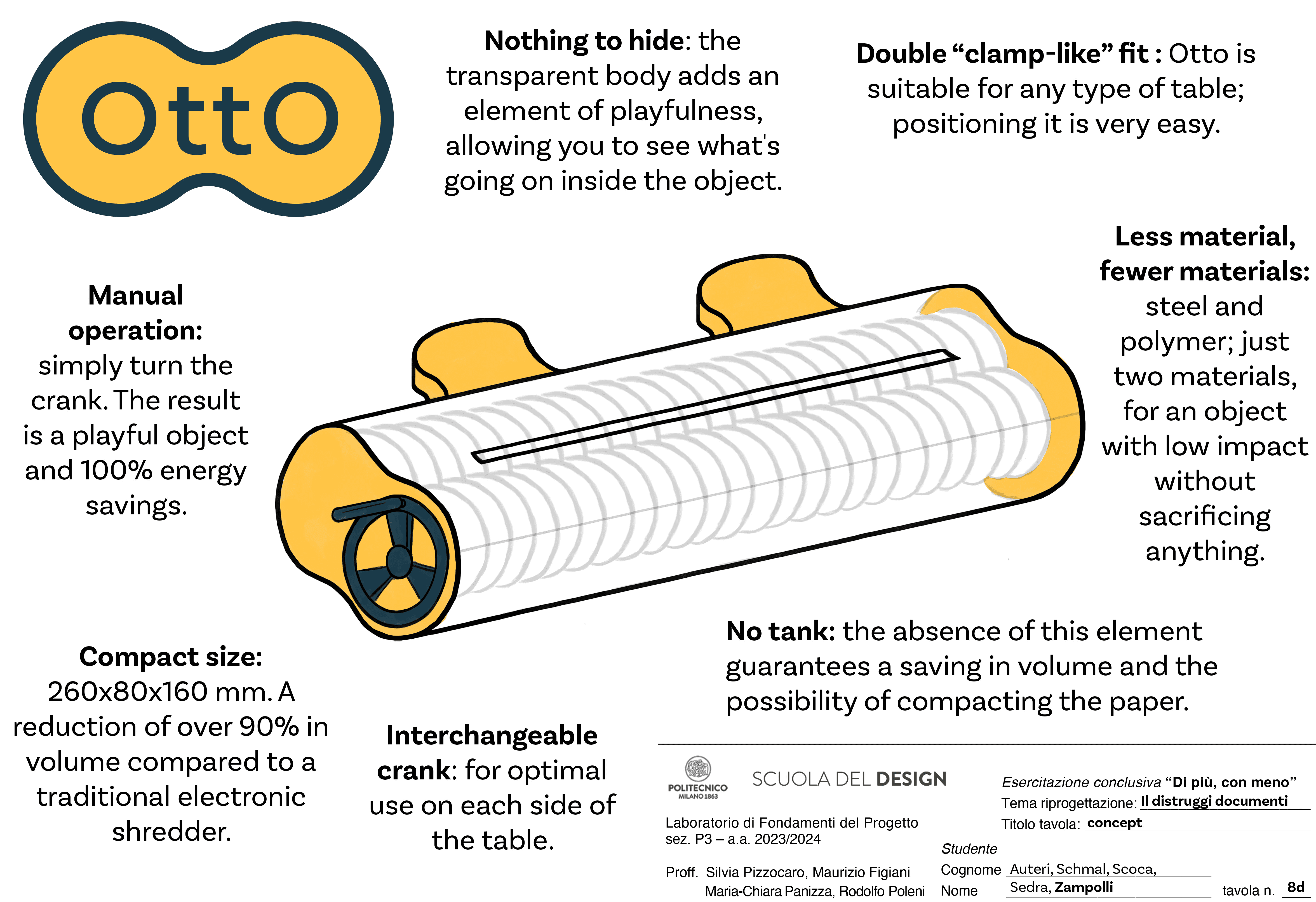
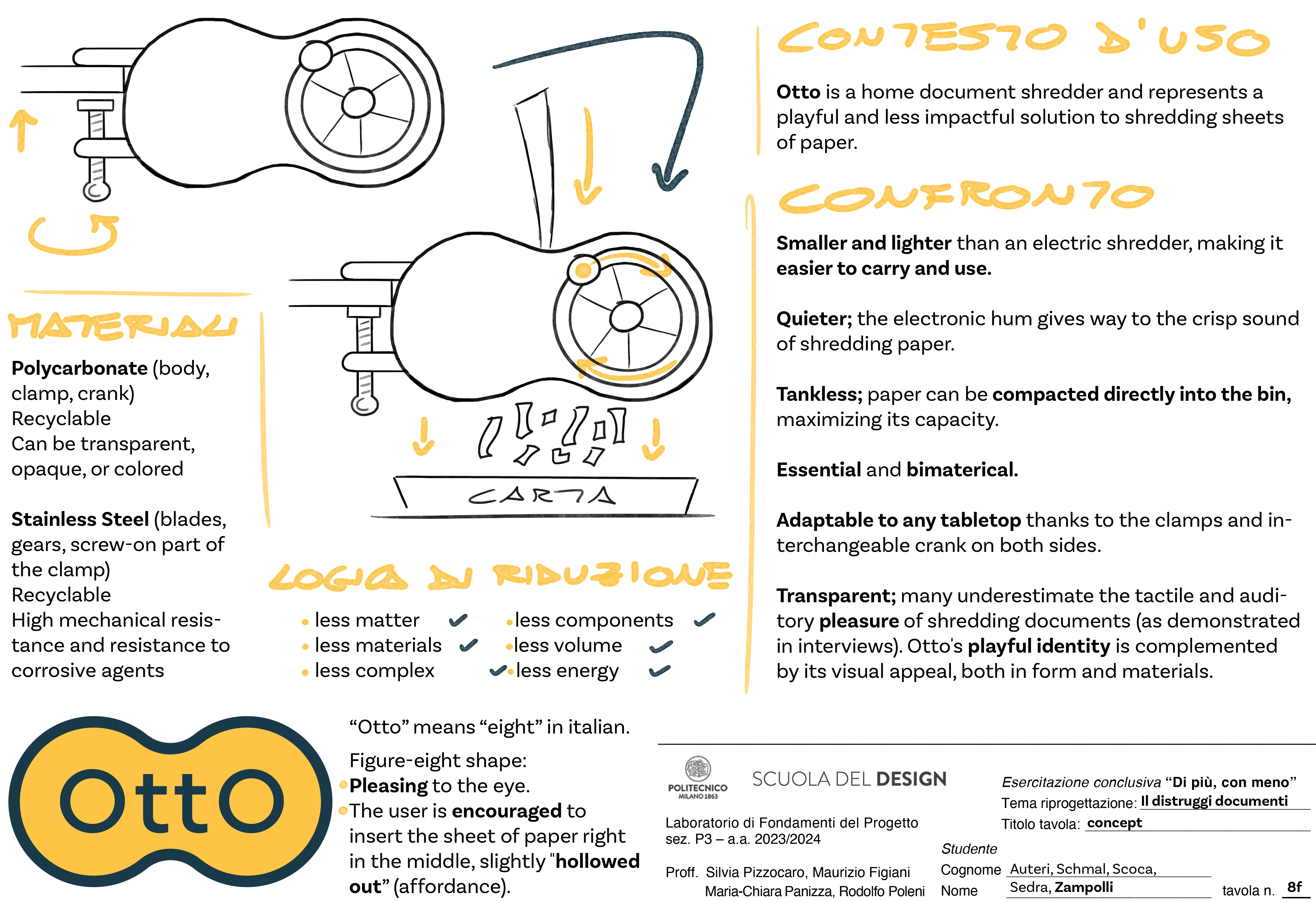
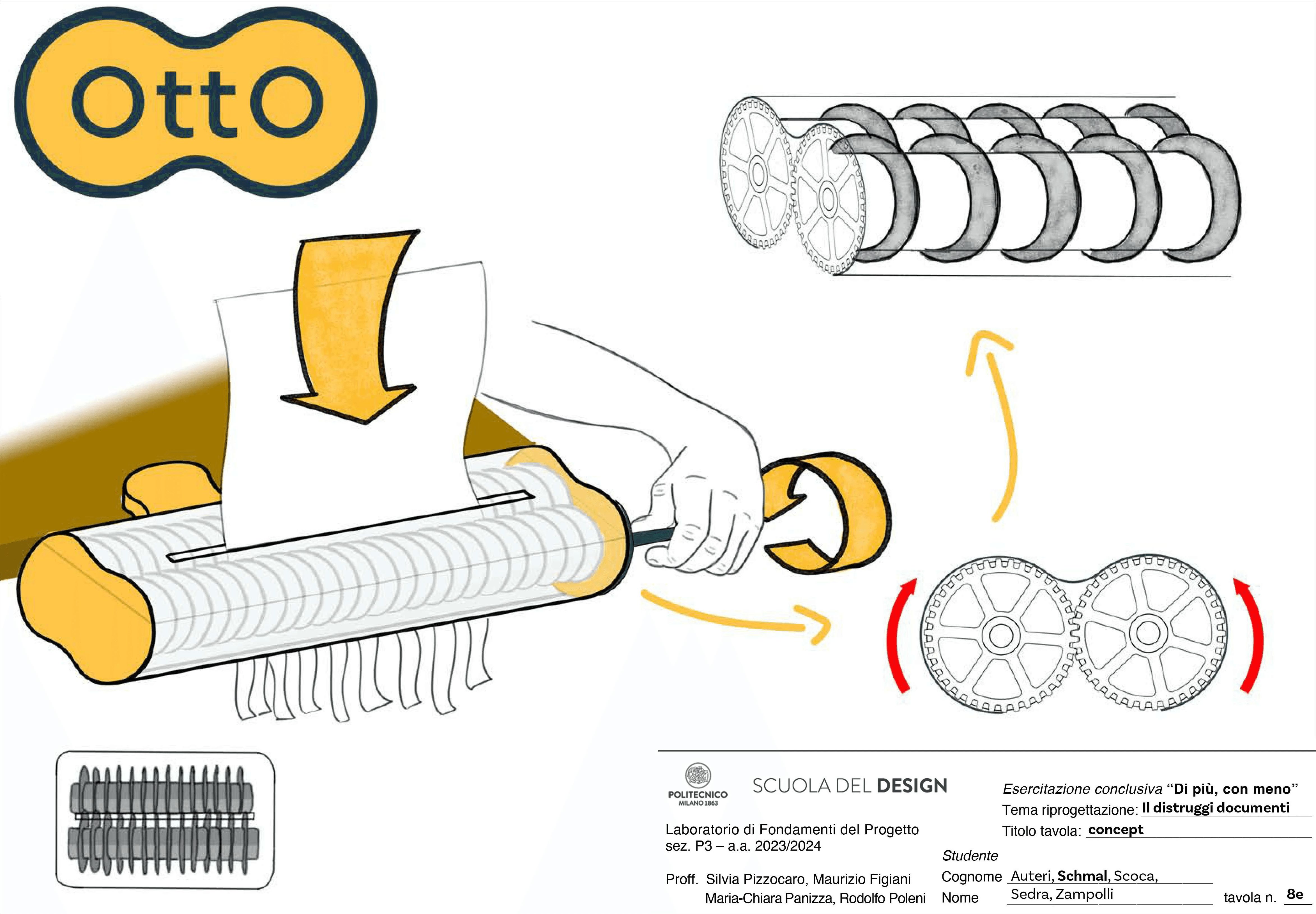
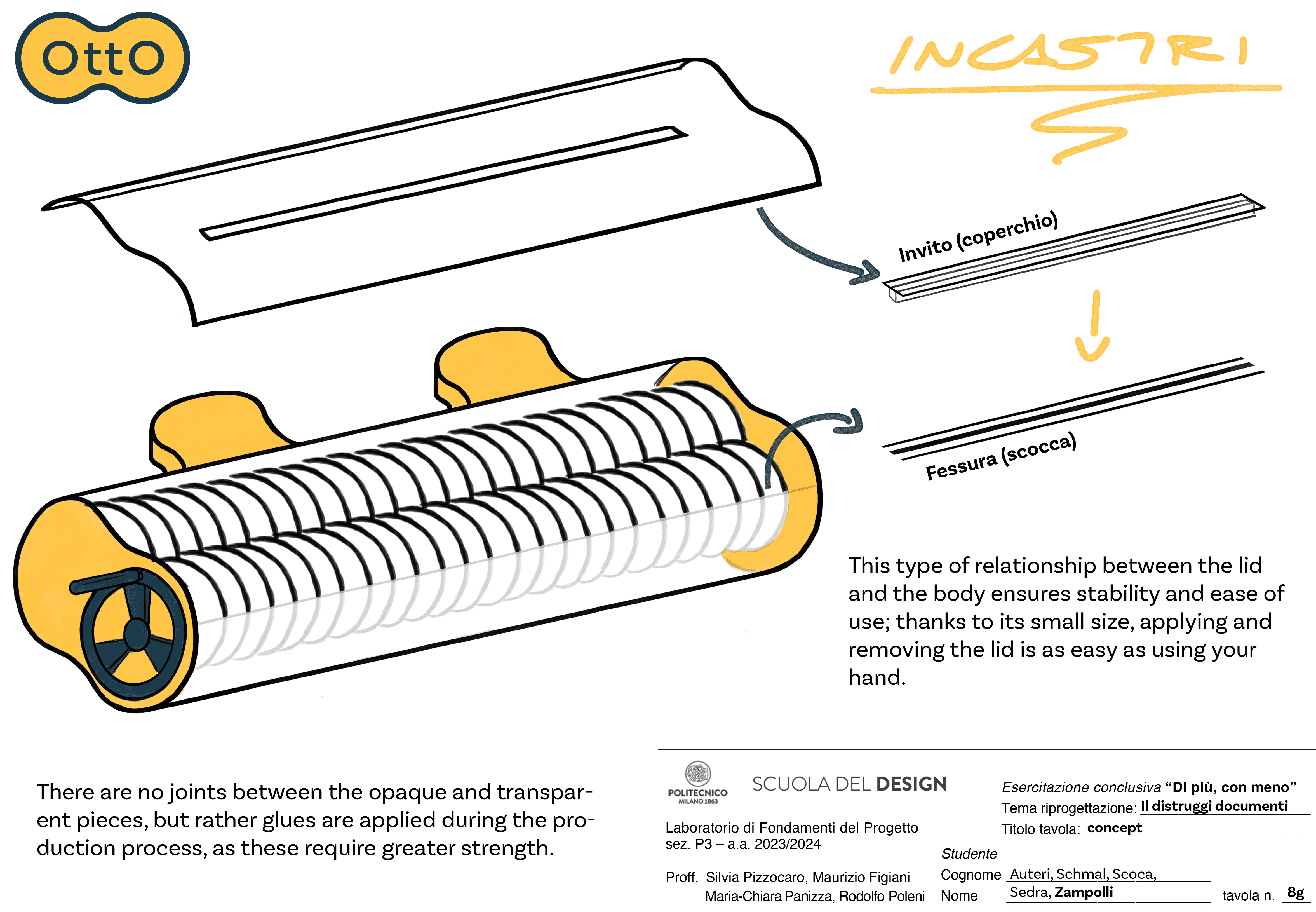
After a series of proposals aimed at shredding paper in every possible way, we conceived Otto, a completely analog shredder that attaches to any table with clamps (ensuring maximum adaptability thanks to the removable crank). The paper strips fall directly into a bin placed underneath Otto, eliminating the "emptying the bin" step required in any shredder.
Final Output
Concept
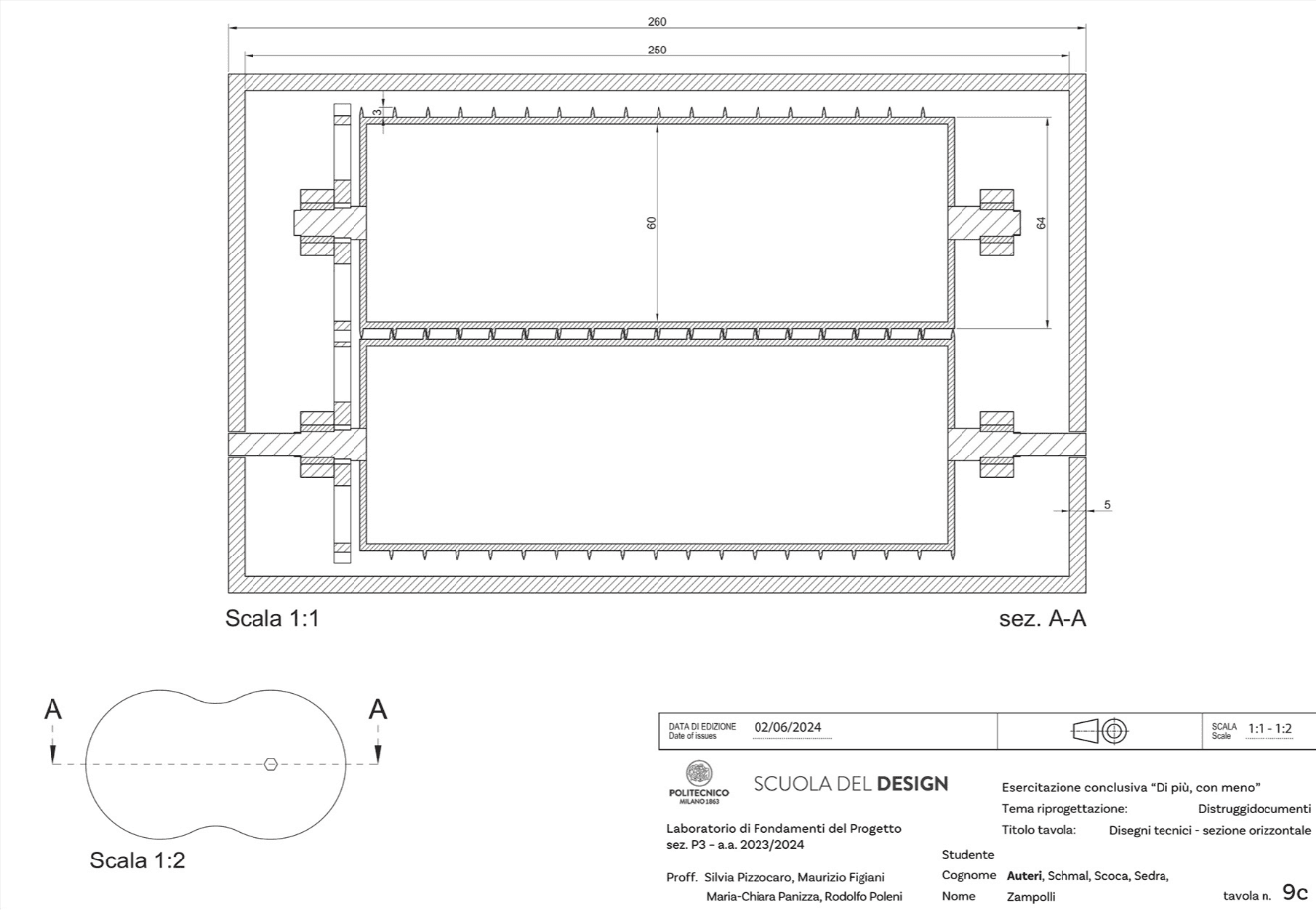
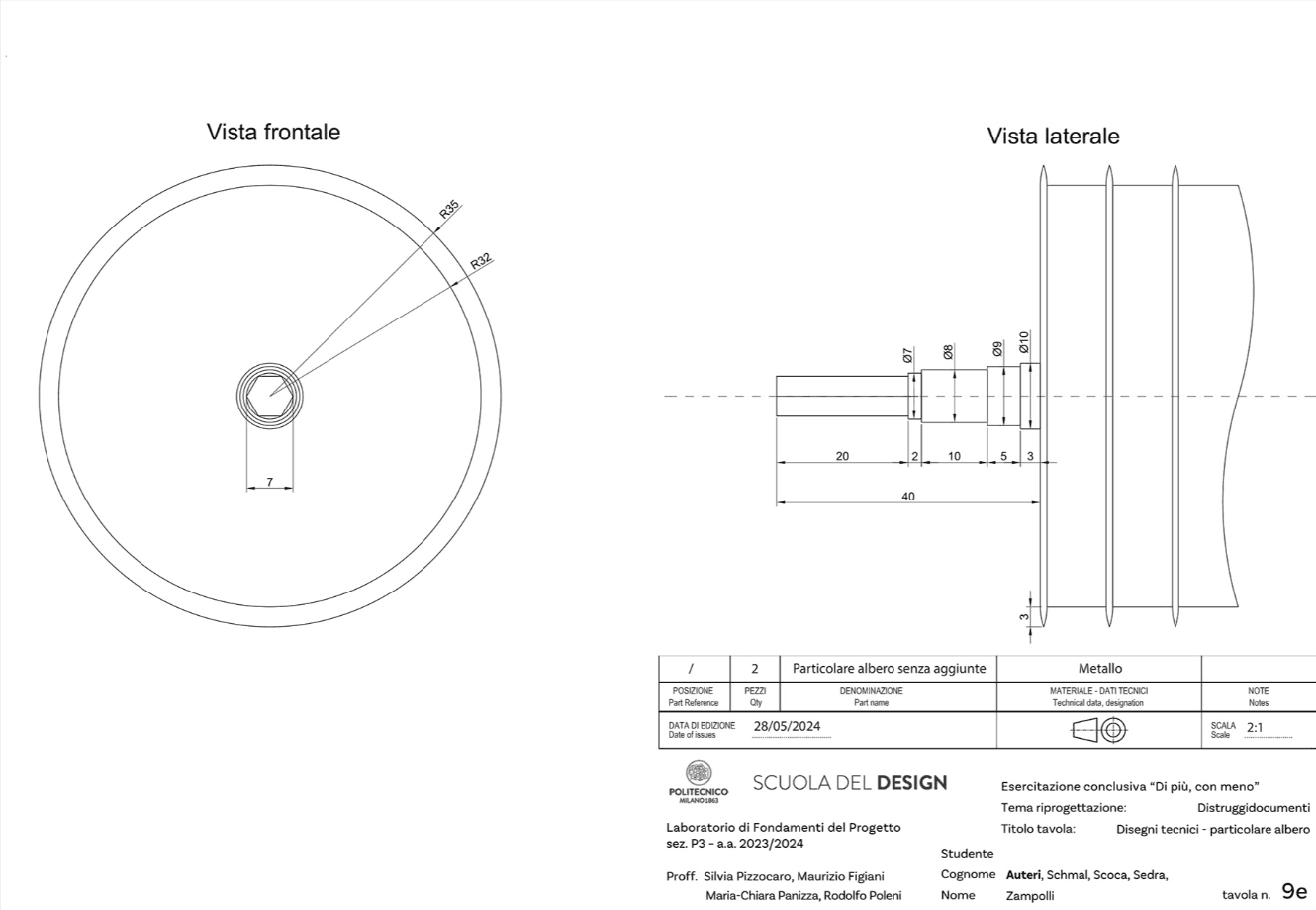
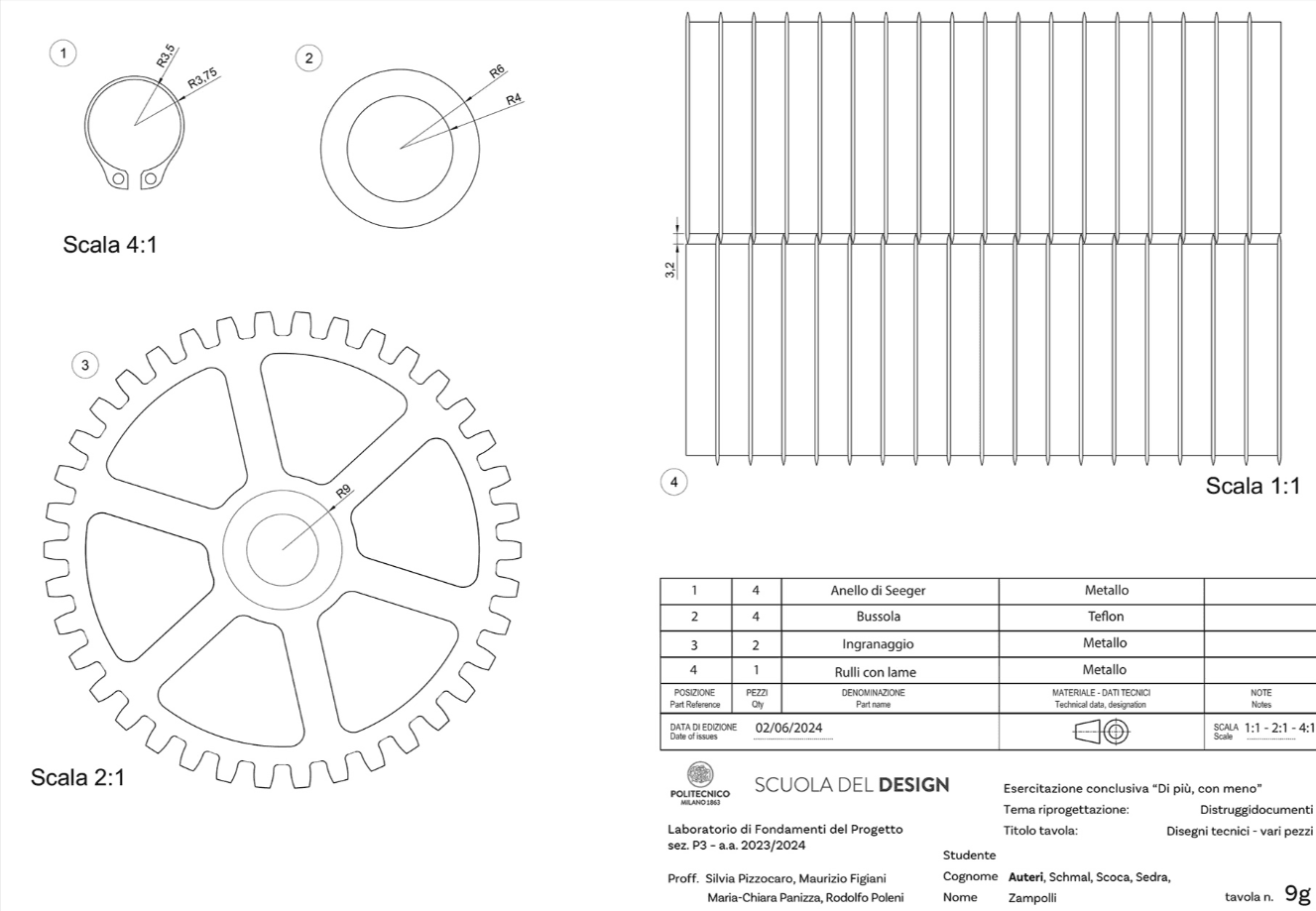
Rollers' Technical Drawings
Digital illustrations
The need to create explicative slides for each milestone of the project allowed me to enhance my illustration skills with the drawing tablet.
Applied interviews
Even if conducted on a small scale, the interviews were crucial for concept generation and an opportunity to improve my user's study skills.
Group catalyst
During the project, I acted as a catalyst in the group dialogue, proposing the design vision that was then selected for the final execution phase.
Sustainably-driven project
Otto's sustainable nature has proven to be its real advantage: it is as simple to use as electronic shredders, but more tactile and gratifying, and has no load limits.
Lateral
thinking, spot-
on solutions.

Time management
During this five-day workshop, I engaged with a new approach to the design process, which put my time management skills to the test within a group dynamic.
New AI tools
In this limited time I explored Vizcom, generating renderigs directly from digital sketches; a fresh, fast approach perfectly suited to this type of workshop.
First fashion approach
I seized the opportunity to explore a completely new field—fashion design—for the first time and to further broaden my horizons.
Otto
Otto is an analogical paper shredder, attachable to any table thanks to its clamps, born from the need to simplify and make its electronic counterparts on the market more sustainable.
PROJECT LINEUP
Group of five people.
ROLE
Market research, user research, concept generation, illustrative drawings.
BRIEF
Choose an electrical appliance considered over-engineered and simplify it by designing an analogical and sustainable alternative.
NOTES
The project was developed as a group for the Laboratorio di Fondamenti del Progetto (Project's Fundamentals Laboratory).
The final output required was a moderately advanced concept, appropriate for a first-year university student. No physical models or digital renderings were required.
Market Research
Before proceeding, it was necessary to gain a thorough understanding of the object to be redesigned, analyzing in more detail how a document shredder works and cataloging the various options available on the market.

The next step was to interview people who were used to using a paper shredder in real life, in their office.
User Research
This short interview phase proved to be crucial within the project, because it precisely directed the concept generation phase: designing an object that makes document shredding both sustainable and playful, focusing on the satisfying feedback of paper shredding that emerged right in the interviews.

After a series of proposals aimed at shredding paper in every possible way, we conceived Otto, a completely analog shredder that attaches to any table with clamps (ensuring maximum adaptability thanks to the removable crank). The paper strips fall directly into a bin placed underneath Otto, eliminating the "emptying the bin" step required in any shredder.

Indoor Tree
A strong reference to nature and Japanese aesthetics. The tree is supported by a special soil base and a circular skylight that provides sunlight; these two elements represent a sort of balance between earth and air and are therefore the heart of the entire house, both for its central location and for what it represents.
Concept Generation
Indoor Tree
A strong reference to nature and Japanese aesthetics. The tree is supported by a special soil base and a circular skylight that provides sunlight; these two elements represent a sort of balance between earth and air and are therefore the heart of the entire house, both for its central location and for what it represents.


Final Output


Green Wall
Together with the tree, it is the green heart of the home; a natural barrier that doesn't interrupt the spacious open space that characterizes the apartment, while still providing a certain amount of privacy to the sleeping area.

Industrial pillar
Used in synergy with the bookcase, it provides a contrast to the traditional softness of the wood.

Concept


Never seen collaboration with the company
Being so close to the company during the design process encouraged me to get involved, ask questions to experts, and learn as much as possible about ceramics.
Management role
During the design process, I often found myself taking on roles related to the project's identity, research, dialogue with more experienced people in the sector, and product presentation.
Lateral
thinking, spot-
on solutions.

Never seen collaboration with the company
Being so close to the company during the design process encouraged me to get involved, ask questions to experts, and learn as much as possible about ceramics.
Management role
During the design process, I often found myself taking on roles related to the project's identity, research, dialogue with more experienced people in the sector, and product presentation.